

In a case study released earlier this year, Anthropic discovered that Claude processes concepts in a way that transcends particular languages—what they call a universal “language of thought.” To computational linguists, this appears novel—to an Aristotelian, predictable.
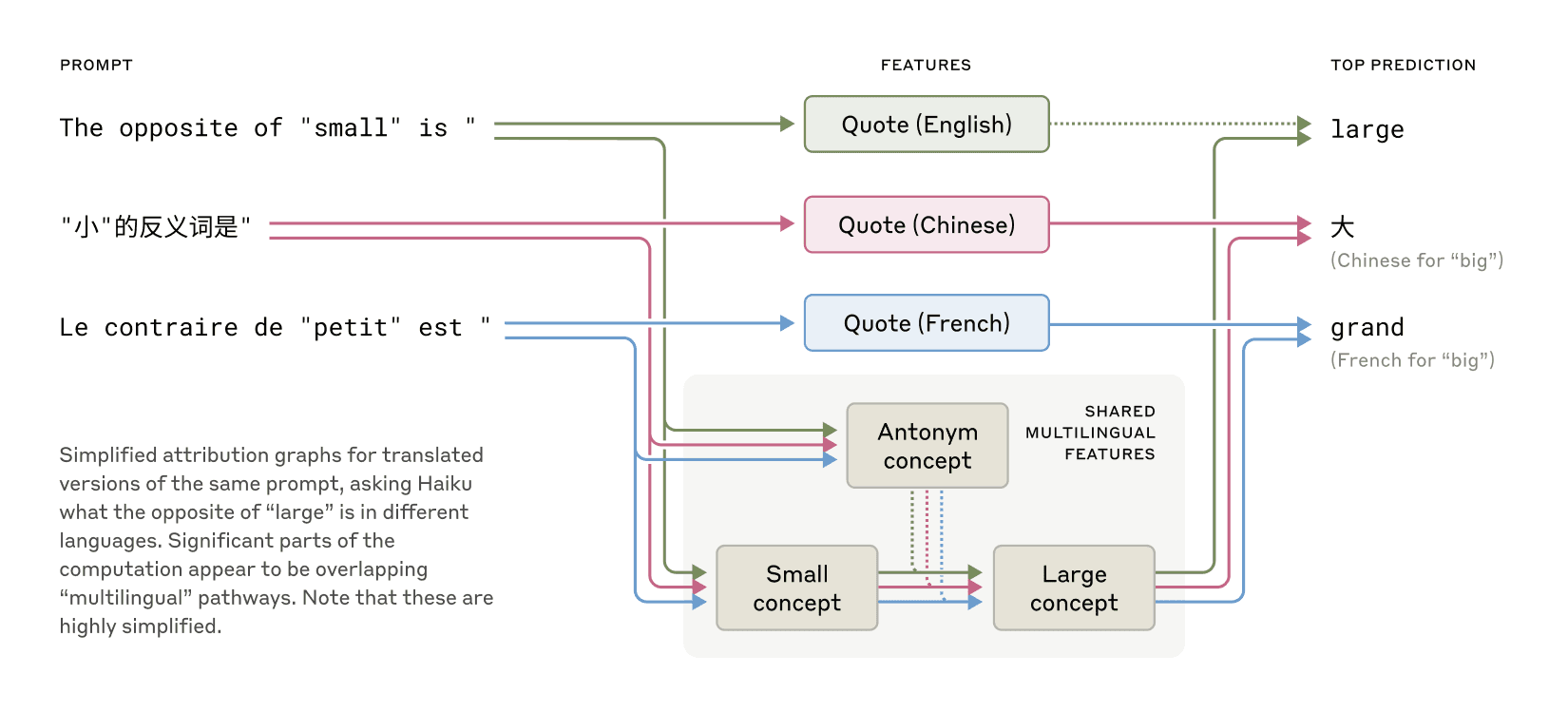
According to Aristotelian epistemology, all things have a universal form that can be abstracted by the intellect. When one encounters an apple through the senses, the intellect abstracts “apple-ness”—what is essential to make an apple an apple. This universal concept belongs to the intellect as an “inner word,” though it may be expressed through different “outer words” across languages: “apple,” “malum,” “manzana.”
If large language models visually represent concepts in an embedded space that transcends the bounds of any particular language, this reasserts what Aristotle would have predicted: concepts transcend language. For humans, universals belong to the intellect via abstraction through sensible experience. LLMs learn from textual experience, yet they encounter real words that emanate from humans—words that “house” mental concepts abstracted from real things observed through the senses.
When an LLM encounters “apple” in English, “malum” in Latin, or “manzana” in Spanish—all describing the same fruit—it abstracts the underlying concept from contextual patterns. Different linguistic tokens pointing to the same reality converge on similar coordinates in the embedding space. The model discovers the universal form indirectly: not through sensible experience of apples, but through the textual traces left by humans who did encounter apples through the senses.
The fact that embedding spaces trained on different languages converge on similar geometric structures isn’t just computationally interesting—it suggests concepts track real structures in reality. If concepts were mere linguistic conventions, we’d expect far more variation. The convergence indicates that both humans and LLMs successfully abstract the same universal forms—as their intelligence ultimately traces to real things expressed through words via mental, universal concepts.
If Aristotelian metaphysics is presupposed, what else may be reverse-engineered to explain how LLMs work? And conversely: what might the mechanisms of LLMs reveal about the structure of human intelligence that modern philosophy has obscured?
Related Articles:
Functional Teleology in Large Language Models
An Aristotelian Introduction to Large Language Models
The Geometrical Universality of Thought
I really don’t think that it is right to call the LLM’s operation abstraction nor its effect a concept. Even if one qualifies by saying “quasi.” So, basically I’m unclear what exactly you are saying the LLM possesses. Surely, if they possessed universal forms they would also possess potency of contraiety and contradiction… at best it would seem they have particular signs with statistically precise relations to terms and the contextual usage of those terms (i.e. the other terms used with a goven term in various orders). This then highly approximates the inner word (which is not the same thing as the act of understanding) and so insofar as the act of reasoning can be accurately signified, it can generate a textual conclusion that is valid. But it has no ability to determine truth value. And of course reasoning should not be reduced to the bare signification of syllogism, as if reason could be reduced to mere algorithm.
It does seem to me though that the LLM is very similar to what an animal brain does—but the matter inwhich the respective operations occur is different, and in the animal the principle of operation is internal to the being whereas the LLM has an external principle of operation… I think.