

Here’s a mental model if you want to follow along: https://conceptual-spaces.vercel.app/ (GitHub)
Abstract
Peter Gärdenfors’ conceptual spaces framework represents a significant advance in cognitive science by proposing a geometric model of cognition that fills in gaps of symbolic and associationist accounts in explaining prototypical categorization and similarity judgment. This paper argues that in developing this framework, Gärdenfors has independently recovered something very similar to the cognitive structure of Aristotle. Surveying the Aristotelian-Thomistic cognitive hierarchy pinpoints where the conceptual spaces framework can be ontologically grounded and expanded. The paper concludes with preliminary observations on the implications of this analysis for Large Language Models (LLMs), arguing that better philosophical accounts of cognition may inform better LLM architectures, and that the Aristotelian-Thomistic framework provides the most complete account currently available of both what cognitive geometry correctly models and what lies irreducibly beyond it.
I. Conceptual Spaces: A Geometric Framework for Cognition
Peter Gärdenfors defines the role of a cognitive scientist as formulating theories around cognitive phenomena and constructing models that represent said phenomena.1 Over the past few decades, there have been two dominating kinds of models to represent how human cognition forms concepts. On one end of the spectrum, cognition is essentially modeled as symbolic manipulation. On the other end, cognition is the statistical association of encountered things. Each of these models lacks cohesion on its own, but need not be in competition if their advantages may be unified into an overarching framework. Gärdenfors proposes his “conceptual spaces” framework as this unifying framework, representing information as geometrical structures rather than mere symbols or statistical associations surfaced by neurons.2
The symbolic model holds that cognition operates through computations on symbolic representations (i.e., language) according to formal rules (i.e. the rules of logic and computation) that are indifferent to meaning. The approach of associationism, on the other hand, holds that concepts emerge from the statistical associations of mental representations derived from experience. In practice, these models are inseparable: symbols represent objects, experience produces associations of qualitative properties on symbols, and formal comparisons are computed to establish similarities and differences. Gärdenfors sees both models as complementary and proposes an overarching geometric framework—called conceptual spaces—to more robustly model how similarities (and differences) are perceived and reasoned about.3
Interestingly, conceptual spaces appears to capture the dimensional nature of sensory input which is independent of symbolic representation.4 For example, there are four receptors that map to the human perception of taste: saline, sour, sweet, and bitter. Hence, the qualities of taste can be modeled by a four dimensional shape.5 Any object that activates taste may be mathematically plotted somewhere within this four-dimensional space to represent its unique quality. Then, qualitative similarities and differences may be calculated by the proximity and distance across the dimensions of this shape. A similar representation could be made from the hue, saturation, and brightness received through sight.
While acknowledging some fascinating connections between sensory input and the potential to geometrically model them across multi-dimensional lines of quality, Gärdenfors does not claim to present both a scientific theory of a geometric structure of reality and their cognitive representations—and certainly not a theory for scientific and psychological connection. Rather, he consolidates his aims to the latter, leveraging geometric representations of objects based on quality dimensions to better explain how concepts are perceived in our reasoning.6 While this framework is more focused than that of Aristotle’s, as shall be discussed below, it is expansive relative to the symbolic and associative models mentioned above. Beyond the structure of sentences in language, there are terms with meanings that exceed their grammatical structure; beyond a probabilistic association of terms, conceptual spaces seek to model terms within a geometric space grouped by sets of qualities, capturing the structural relationships between categorizable terms (i.e., concepts) and their qualitative properties that neither formal rules nor statistical associations alone can entirely represent.7
More precisely, Gärdenfors enumerates the following taxonomy. The building blocks of a conceptual space are quality dimensions. A quality dimension represents the geometrically measurable range of a quality of an object, such as weight or temperature.8 Quality dimensions may be classified as integral or separable. They are integral when multiple qualities always come together in a single perception, such as hue, saturation, and lightness also being coupled together when perceiving color. When dimensions can vary independently, they are separable. A domain is the space constituted by a set of integral dimensions that are separable from all other dimensions, such as the color space that is comprised of three integral dimensions of hue, saturation, and lightness for a perceived color. Within a domain, specific ranges of values correspond to a region, like the range of hue, saturation, and lightness values that constitute all shades of red within the color space.9 A region is convex when its range of values is “self-contained,” meaning they do not “bleed into” other regions For instance, the values constituting red are convex because they form a coherent continuous range that does not pass through orange or pink to get from one red shade to another. A conceptual space is a collection of one or more domains.10
From such a conceptual space, Gärdenfors distinguishes two kinds of structures: properties and concepts. Properties are convex regions of a single domain, such as the convex region representing all shades of red. In contrast, concepts are convex regions within a set of interconnected domains, such as apple spanning the color and taste domains which describe some of its qualities. Within this space, particular objects are represented as points which are specific objects (i.e. individual things) plotted at precise coordinates across relevant quality dimensions.11
A key strength of this framework is that it models how judgments of similarity are made across cognitive processes.12 Within a conceptual space, similarity between any two concepts is measured as geometric distance. The closer two concepts are in the space the more similar they are. Crucially, these judgments are context-sensitive. Without context specified, apples are generally seen as more similar to tomatoes than dates; however, in the context of dessert, where sweetness is the most relevant feature, the similarity judgment shifts and apples become more similar to dates, since both are sweet and tomatoes are not. The framework accounts for this through a weighted distance measure. In this measurement, the different dimensions—each representing a different contextual property—may be assigned higher weights, effectively magnifying those dimensions in the distance calculation and shifting which concepts appear most similar.13 This eye toward context is what allows conceptual spaces to model the dynamism of human similarity judgments that neither formal rules (the symbolic model) nor statistical associations (associationism) alone can capture. On this point, the advantage of Gärdenfors framework comes into focus.
Part of that dynamism of similarity judgements involves not only context but also default expectations. This, too, is modeled by the conceptual spaces framework. According to the prototype theory of categorization, the objects that people judge as most representative of a categorical concept (modeled as a region) are called prototypes. Robins are judged to be prototypes of the categorical “bird” concept, rather than, say, penguins.14 Each prototype, therefore, represents the maximal inclusion of the various properties that are members of a categorical concept. For example, a robin maximally includes the properties that one expects from a bird (its category): wings, beak, nest-builder, singer, flyer, etc. whereas an ostrich neither flies nor sings.15 Gärdenfors formalizes this through a typicality measurement, measuring how far from the prototype you can travel before a property ceases to hold. Properties that hold across nearly the entire concept region have high typicality. These properties are what is generally the default expectation: beak, nest-builder, singer, flyer, etc. Properties that hold only near certain parts of the region have low typicality, such that a bird that cannot fly will be further away from the prototype. Hence, the greater distance from the prototype visualizes a lesser expectation, and the greater proximity represents a higher expectation. This produces an ordering of properties from most to least expected, reflecting their degree of defeasibility, meaning how easily new information overrides the expectation. This typicality ordering may clue us in on what properties are most essential, however, it ultimately reflects observed instances.16
To measure which properties of a categorical concept are most differentiating, Gärdenfors measures diagnosticity. Not only is the property of wings highly typical, it is highly diagnostic, for wings distinguish birds from other animal categories most significantly. Diagnosticity is calculated as the ratio of a property’s typicality within the concept to its typicality within the immediate superordinate category. Crucially, the model is not probabilistic, meaning some properties that are statistically probable are not prototypical. For instance, the adult turtle is the prototypical turtle even though it is most probable that turtles die before adulthood.17 This implies that there is something beyond statistical frequency to determine the prototype, distancing this framework from associationism.
So far, the prototypical categorization of concepts has only been considered with respect to default expectation. However, typicality also emerges when we choose to communicate in generalities about known concepts, as in “Sharks kill people.” Statistically, this is not universally true, for not every shark will kill someone in their lifespan. Hence, common generalities don’t always map to mere statistical probabilities. We say “Sharks kill people” despite shark killings being relatively rare.18 Moreover, “[Most] Turtles die before adulthood,” doesn’t feel as certain of a truth claim as “Sharks kill people” despite being more probable. Gärdenfors acknowledges that a logician would employ quantifiers to turn imprecise generalities to certain truth claim: “Some sharks kill people.”19 However, as established in the onset, Gärdenfors’ aim is phenomenological: Why does “Sharks kill people” feel certain despite being a statistically low occurrence, and how can this phenomenon be modeled through the conceptual spaces model?
To answer this, Gärdenfors distinguishes between three types of properties: defining properties that constitute the core meaning of a categorical concept, characteristic properties that refer to general knowledge about the category (though exceptions are possible), and accidental facts which are facts that rely on entirely specific circumstances. “Tigers are mammals” includes a defining property; “Tigers are striped” includes a predicate that is a characteristic property (it is usually the case); and “Tigers can be found in the Himalayan foothills” is an accidental fact that is neither characteristic nor defining of tigers, and a rather unique circumstance for particular instances of tigers.20
This tripartite distinction explains the degrees of phenomenological strength resulting from the various kinds of generics. The conceptual spaces model generally surfaces that the strength of a defining or characteristic property of a categorical concept maps to the degree of typicality. Trunks of elephants have higher typicality than their greyness despite both being characteristic properties. This captures a complexity that probabilistic associationist models flatten. Paperback books are highly probable yet not a characteristic property. Furthermore, the strength of expectations around generics can be ordered within a conceptual space in a way that the logic of a symbolic model could not surface.21
As noted in the “Sharks kill people” example, generics often contain a property that is diagnostic for a concept, a property that differentiates the concept from its sibling members of that category.22 Killing people is a property of sharks that carries phenomenological strength, as measured by typicality, because it distinguishes it from many sibling fish concepts, but an electric eel also possesses the same diagnostic property of killing people. Hence, Gärdenfors model implies that a striking generic, due to its high typicality and often diagnostic predicate, may emerge while not being enough to create a full separation from a sibling class; presumably, it is a set of diagnostic properties that distinguishes, and these diagnostic properties are identified through the interplay of typicality and diagnosticity. Measuring the diagnostic strength of a property allows for identifying the most unique features of concept—with respect to its superordinate categorical concept and all its sibling concepts within that superordinate category—in a specific order.23
Hence generics are the linguistic expression of the typicality-diagnosticity interplay, meaning their phenomenological strength reflects the underlying geometric relationships between concepts rather than mere symbolic manipulation or statistical frequency. To determine the typicality of a property within a concept (e.g., how striking a feature of a shark), one measures how much of the concept space is covered by the property’s region (e.g., how much of the shark concept space is covered by the killing-people region). To determine the typicality of a concept that is a member of a superordinate concept (e.g., how strong a great white shark is associated with sharks), one measures how close the concept’s region is to the prototype of the superordinate concept (e.g., how close the great white shark’s region is to the prototype of the shark’s concept space). To determine the typicality of an object, meaning the typicality of an instance of a concept (e.g., how strong this shark corresponds to a typical shark), one measures the distance from the point representing the object to the prototype within that concept (e.g., how close is this shark is to the prototype of shark).24 Presumably, three measurements for the kinds of diagnosticity can be measured; however, Gärdenfors only makes the diagnosticity of a property of a concept explicitly. This is measured by taking the typicality of the property with respect to its immediate concept and dividing it by the typicality of that property with respect to its superordinate concept (e.g. the typicality of killing-people with respect to sharks divided by the typicality of killing-people with respect to fish).25 Determining the diagnostic properties of each concept reveals what is most typical for each concept, and how a concept is differentiated from both its superordinate concept and its siblings that are also members of that superordinate concept. Typicality and diagnosticity, therefore, do not only inform the phenomenological strength of generics (and, presumably, other linguistic patterns), but they also inform the similarity and differences across a hierarchy of things, which are instrumental in the reasoning process through which knowledge acquired.26
Just as generics surface the impact of phenomenological strength on comparing and contrasting objects through categorization—as can be modeled geometrically in a conceptual space, described in terms of typicality and diagnosticity, and used for identifying similarities and differences under-asserted by symbolic and associative modeling—so too, according to Gärdenfors, linguistic expressions of property projection reveal a cognitive ability to reason through uncertainty because of the phenomenological strength of categorical similarity. Consider the statement “Dogs have teeth; thus, cats have teeth.” The property of teeth-having is being projected onto cats, presumably because of a perceived similarity between dogs and cats in other features. The logician would explain that such a statement involves an enthymeme, that is, an implied premise. The unstated premise in the dog-cat-teeth example is that there is sufficient biological similarity between dogs and cats to perceive shared teeth-having as plausible. However, this logical observation does not measure the phenomenological strength that drives the projection, the advancement in knowledge despite uncertainty. Gärdenfors labels this advancement during property projection category-based induction. Through category-based induction, an unknown concept can be reasoned about by drawing from one’s internalized conceptual space. In some cases, there is specific property projection which operates within a single concept, such as projecting laterally from robin to crow from within the same superordinate concept of bird. At other times, there is a general property projection when the projection jumps from a concept to a superordinate concept, such as from robin to bird.27
The strongest force behind both specific and general property projections is the categorical similarity between the concepts supposedly sharing a property. For instance, “Ostriches have enzyme E, thus emus have enzyme E” is a stronger general projection than “Ostriches have enzyme E, thus robins have enzyme E” because ostriches and emus are more categorical similar than ostriches and robins, as the conceptual spaces framework can model and measure geometrically. Likewise, “Cats have teeth, thus dogs have teeth” is a stronger specific projection than “Cats have teeth, thus hippos have teeth” since cats and dogs have greater geometrical proximity.28
Additionally, the typicality of categories likewise exerts a positive force on the expectations of property projections. “Robins have enzyme E; thus, ostriches have enzyme E” is a stronger specific property projection because robins are more typical, that is, closer to the prototype of bird, than ostriches. Substituting “penguins” for “robins” in the first premise would result in a weaker projection since penguins are less typical than robins. Typicality also strengthens projection when the highly typical category appears in the conclusion, such as in “Chickens have wings, thus robins have wings.” However, the projection is always stronger when the highly typical category appears in the opening premise rather than the conclusion, for typicality exerts greater force from the premise position than from the conclusion position. Thus, the typicality effect in projections is “asymmetrical” with respect to strength.29
Since traversing from a concept to superordinate concepts progressively increases the degree of abstraction, and the inverse increases homogeneity, general property projections are stronger when the category in the conclusion is more homogenous. For instance, “Robins have organs, thus blue jays have organs” is a stronger projection than when there is a more abstract concluding category such as in “Robins have organs, thus mammals have organs.” Hence, the more abstract a concluding category, the more strength is needed from the preceding premises to strengthen the overall argument. This phenomenon is homogeneity. Similarly, an argument is strengthened by the inclusion of more sibling concepts when concluding toward something about the superordinate concept, as in “Robins have organs, dogs have organs, and horses have organs; thus, mammals have organs.” Such is an instance of monotonicity. However, adding categories that aren’t siblings (i.e., that do not belong to the same superordinate category), makes the argument weaker, as in “Robins have organs, dogs have organs, and insects have organs; thus, mammals have organs.” This is called nonmonotonicity. The reason, in our example, is that adding “insects” to a mammals argument shifts the evoked superordinate from mammal to animal, and the premises now cover less of the animal space than they covered of the mammal space. Finally, there is the phenomenon of diversity wherein less similar premise categories can produce stronger arguments because their properties cover more of the superordinate category space. For example, horses and seals support a mammal conclusion more strongly than horses and cows because their greater diversity, being less similar to each other, covers more of the mammal conceptual space, greater strength for the conclusion.30
Distinct from these inferential mechanisms described above are analogies. Analogies enrich conceptual knowledge by mapping structural relationships across domains, accentuating similarities between concepts. The conceptual spaces framework can explain these analogical mechanisms that are sparse in evidential literature.31 An analogical relation identifies a shared dimension, called an analogy factor, along which two pairs of concepts converge. In brief, analogies leverage similarities in conceptual structure, and, therefore, computational systems that embrace this structure may yield advanced search algorithms that simulate analogical reasoning. These algorithms should identify the most salient dimensions when comparing category to category or category to property. Analogies that couple highly salient dimensions are the best analogies, as demonstrated by their efficient processing speed.32
II. Aristotelian Unification
It appears that in formalizing a conceptual spaces framework from the disparate insights of cognitive science, Gärdenfors has surfaced a phenomenological model analogous to Aristotle’s metaphysical one. He moves from observations that are the proper object of cognitive science toward a geometrical representation of them. Given his commitment to the “phenomenal” over the “scientific,” the model is constructed off of psychophysical measurements. He admits that this is not a “realistic” construction of the world, but a structuring of perceptions.33 This framework for comprehending perceptions is rich and makes a genuine advance that provides a satisfying account for conceptual organization, similarity, typicality, analogy, and induction. Tersely, that mechanisms of inference are best explained by geometry is the cutting insight—but is it absolutely novel? There is a geometry to the Aristotelian system, and as shall be discussed, there are strong similarities in their respective models. However, Aristotle’s metaphysics implies that any geometrical model would truly conceptualize real, essential similarities and differences between things; Gärdenfors’ model, on the other hand, surfaces similarities and differences by a strength of phenomenological force. Rather than simply exposing contrasts and cataloging limitations, I’d like to take a page out of Gärdenfors’ playbook and attempt to unify these cross-illuminating models to strengthen each despite the historical distance.
To unify these frameworks, the terminology needs to be normalized. In the conceptual spaces framework, a domain is a geometrical space constituted by a set of dimensions, separable from all other dimensions, that represent various qualities, such as the color space consisting of hue, saturation, and lightness dimensions for a particular color. Concept can span multiple domains, and generally have a superordinate concept representing a category that subordinate concepts are members of. In Aristotle’s framework, these concept regions normalize to genera (plural). Subordinate concepts each form a convex region within the superordinate concept (moving vertically) and possess sibling concepts that are likewise members of that superordinate concept (moving horizontally). These subordinate concepts normalize into species (plural). As siblings belonging to the same superordinate, categorical concept there must be similar properties yet some distinguishing, diagnostic property—analogous to differentia (singular) which distinguishes a species from its siblings within the genus (singular). For Aristotle, a species is defined by the genus plus the differentia (e.g., “human: rational animal”), describing the essence (i.e., whatness) of a thing. For Gärdenfors, the diagnostic, defining property is just one of three kinds of properties. There is also the characteristic property that is a highly typical property but ultimately defeasible, which normalizes to proprium (singular); and, an accidental fact that describes a circumstantial fact that is peculiar to an instance of a concept, and which normalizes to accidens (singular). However, these Aristotelian terms are claiming real, necessary similarities and differences between things, since every thing has an irreducible essence (or nature). Hence, a proprium is a property that is non-essential but necessarily and exclusively belongs to the subject because of its nature, and accidens is truly a variable property that does not necessarily “flow” from the specific nature of a thing.34 Dogs and cats both belong to the genus of “mammal,” sharing the properties of warm-blooded, vertebrate, producer of milk for their young, possessor of hair or fur, and breather of air that are the differentiae of mammals with respect to sibling animals. Dogs and birds are themselves genera with species underneath them containing various kinds of dogs and birds respectively. Unlike other mammal species, a dog is domesticated from wolf ancestry (this differentia is interesting and worth holding on to). Human-directed social bonding is a proprium of dogs, for it is not an essential yet a unique feature that flows from its domesticated nature; and, finally, dogs may have accidentia (plural) such as being brown, being called “Rover,” etc. Unlike the human-bonding feature, being gray instead of brown does not affect what a dog is by nature.
Together, genus (pl. genera), species (pl. species), differentia (pl. differentiae), proprium (pl. propria), and accidens (pl. accidentia) are the five predicables that can describe the precise relationship between properties and the subject (e.g., dog) as observed from reality. Gärdenfors’ framework measures the phenomenological strength of predicable-like relationships: typicality measures how strongly a feature belongs to a concept and diagnosticity measures how strongly a feature distinguishes it from sibling concepts. There lacks an ontological criterion that can determine whether a property is essential, proper, or accidental. In contrast, the Aristotelian framework flows entirely from an ontological grounding. The properties don’t indicate cognitive salience but the mode in which a property necessarily belongs to a nature. If Aristotelian ontology can be connected to conceptual spaces, then conceptual geometry may be evaluated not only by psychological fittingness, but by its capacity to track real structures in things.
Aristotle’s system not only explains how properties relate to subjects via the five predicables, but it also penetrates into what kinds of things are there to predicate properties of in the first place. The schema for understanding kinds of things are Aristotle’s ten categories. Four are most relevant to the conceptual spaces framework: substance, quality, quantity, and relation. Regarding substances, the primary substance is an individual, existing thing, like “this dog.” From existing things, natures (essences) that capture what things formally are may be derived. In a conceptual space, a substance is the point. Secondary substances, species and genera, are derived from primary substances and correspond to regions and domains. The ontological grounding of properties in primary substances maps onto the distinction between objects as points and concepts as regions in a conceptual space. A point is always within a region, and a region doesn’t “float” independent of the points it contains. Likewise, a species never floats independent from the individual substances from which it is derived.35
Quality captures of what kind, such as being white, round, hot, cold, soft, etc. This is where most of Gärdenfors’ quality dimensions live. The color domain corresponds to color as a quality. On the other hand, the weight domain would be nested under the quantity category representing how much, such as being of 100 kilograms. In Aristotle’s account, quantity is a distinct category from quality; Gärdenfors’ quality dimensions span both Aristotle’s quality and quantity categories without distinguishing them. Hence, in a conceptual space, they are both just dimensions in that space which are formally equivalent as geometric parameters; whereas, for Aristotle, quality and quantity are formally incommensurable kinds of being. Color cannot be derived from size.36
Relation is the category of how a thing stands to another thing, of being related to another. One thing may be double, half, or greater than another. This is where Gärdenfors’ vertical dimension of concepts and similarity measures live. The distance between two concepts in a conceptual space is measurement of relation, capturing how two concepts stand to each other geometrically as a representation of how they stand in cognition. Aristotle’s category of relation is the ontological grounding for what Gärdenfors measures geometrically. While Aristotle’s system does not have the specificity of how exactly things are grounded in cognitive mechanisms, it orders what is modeled geometrically in a conceptual space according to ontological categories rationally induced. Relation is not merely a geometric distance but a real formal relationship between things that share formal properties to varying degrees.37
In total, Aristotle’s categories chart the overarching classifications of all things. This classification is necessary. These are the most encompassing categories that remain necessarily distinct as they stand as formally incommensurable kinds of being. Color cannot be derived from size, nor can size be derived from color. This ontology may explain why Gärdenfors’ domains are separable and why the separability is not merely a cognitive process but an ontological fact about reality. The conceptual spaces framework discovers this separability empirically through psychophysical measurement whereas Aristotle grounds it ontologically through rational analysis of being.
Although Aristotle’s system is rationally derived and recorded in writing, it has the potential to be modeled geometrically.
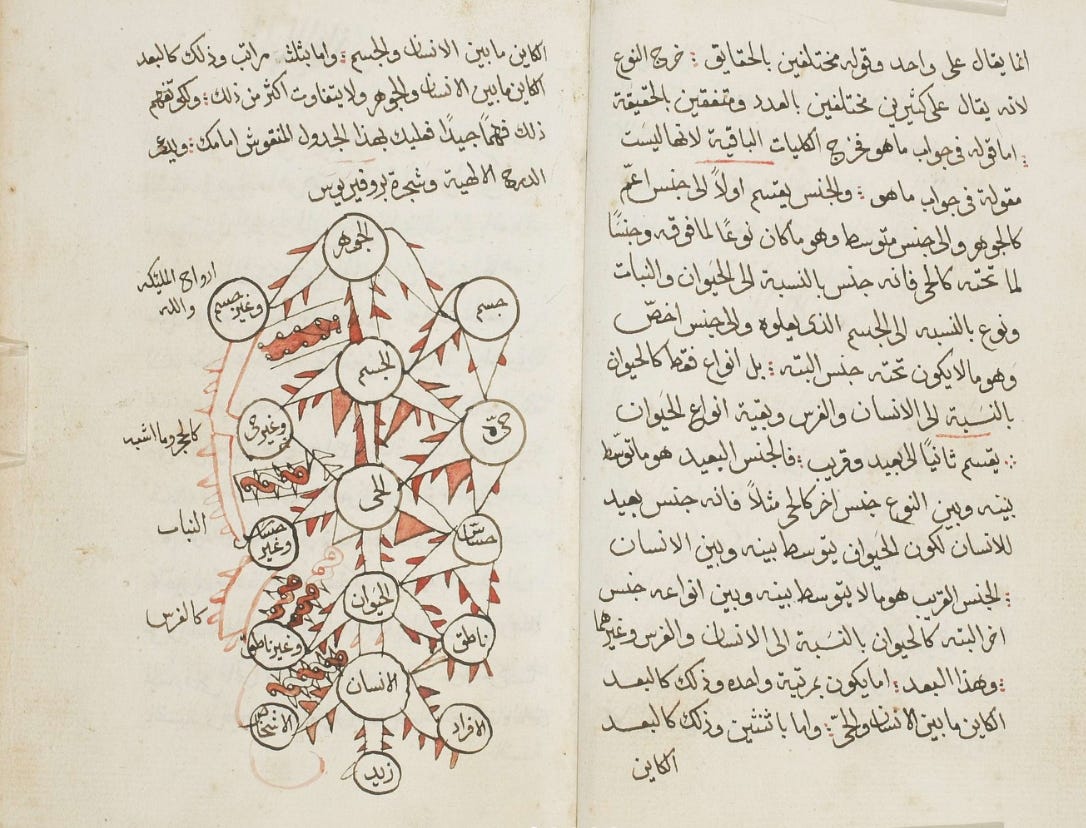
The Tree of Porphyry dates to the 3rd century CE and is attributed to the Greek philosopher and logician Porphyry, transmitted to the medieval West through Boethius. It is a simple discrete structure dividing the categories of secondary substances into disjoint classes with Aristotle’s categories being the top-level categories. A similar structure is the phylogenetic tree used in biology to divide the family of organisms into classes.38 Here, more precision can be employed to pinpoint what the conceptual spaces framework geometrically extends that is not possible from Aristotle’s categories and predicables. The categories and predicables move from the direction of rational reflection, for reason presents incommensurable things that must be separated. Gärdenfors’ system moves from the direction of psychophenomenal empiricism to provide granular geometrical measurements that shape and separate things according to degrees of typicality. Gärdenfors states the limits of classical logic to adequately model the cognitive phenomenon of typicality, and he is correct.39 The question is whether Aristotle’s framework can be reduced to logic, for he does address cognitive mechanisms. He explores the role of sensation, memory, and experience in building knowledge, yet are these mechanisms ordered toward and completed by rational reflection (i.e., an ontology) rather than constituting the whole of knowing? And if ontology is required, what is the ontological mechanism? This is where it gets interesting. Can a point of contact between conceptual spaces and Aristotle’s framework be established so that each can mutually enrich the other?
Aristotle defines demonstration as “an inference from necessary premises,” and it is demonstration that is required to grasp the essence of things, which is the proper object of pure scientific knowledge.40 The predicables, therefore, provide the schema to demonstrate the essential similarities and differences of things, and logic provides the formal rules governing valid demonstration. Now, there must be some principle knowledge upon which inferences can be made. However, if demonstrative, necessary knowledge precedes life experience, then how come we begin life with no notice of having it? Yet, there must exist some means to be able to acquire knowledge, a foundational knowledge to acquire demonstrative knowledge. The solution is that there is a natural capacity to perceive the essential attributes of things, and this mechanism is sense perception.41
However, to move to a demonstration, these perceptions have to remain after the initial contact with the senses. Aristotle posits that there is the natural capacity to remember, called memory. Moreover, when we appeal to experience, are we not but bringing forth something once perceived from memory? Reasoning, then, is the power to compare things experienced with each other to acquire demonstrative knowledge.42 In summary, “Out of sense-perception comes…memory, and out of frequently repeated memories of the same thing develops experience…From experience again originate the skill of the craftsman and the knowledge of the man of science.”43 Here the tension with cognitive science emerges and demands a reckoning with Gärdenfors’ theory. Do we acquire knowledge through the strength of typicality distinguishing things from each other, or is it through rational demonstration from experience? Or, might both be at work at different levels? Aristotle’s answer is both.
Our minds conceive of gala apples as red and sweet. However, sight knows of the color, but not the sweetness; taste knows of the sweetness, but not the color. How can both these senses be simultaneously recognized as distinct yet fused together into a single memory? Aristotle designates common sense as the principle of sense perception that analyzes and synthesizes sensorial data received by a plethora of senses.44 Once sensorial data is synthesized together by common sense, what happens? Images derived from sensed objects are internally impressed. Aristotle calls the power to form images the imagination (phantasia).45 Even when contact with objects through the senses terminates, images are housed as traces of the sensed objects.46 Imagination is like a light that allows us to see that which was once sensed.47 It is a movement caused by the actuated senses yet distinct from it, and, presumably, it is a power separate from the senses.48 Moreover, imagination involves the remarkable ability to create new images ultimately derived from things once sensed: “By [the imagination’s creative] power we can live in other places and are able to project ourselves into situations that we have never actually experienced,working the old familiar patterns into designs that are fresh and new.”49 Memory is a power distinct from the imagination in which an image of a thing is retained as it was apprehended in the past, rather than the universal image of the form of a thing retained by the imagination.50
Having briefly surveyed Aristotelian anthropology, the bridge between Aristotle and Gärdenfors rests in an often-missed distinction in the Aristotelian schema of sensation. Aristotle comments that there are three kinds of sense-objects, and two are perceptible essentially while one is incidental. First, there are particular sense-objects which are the proper object of each particular sense: sight:color, hearing:sound, taste:savor, touch:heat and moisture, cold and dryness, the heavy and the light, etc. These are perceived by one sense but not the other. Second, there are common sense-objects which are perceptible to more than one sense, such as movement, rest, number, shape, dimension. Third, there are incidental sense-objects which pertain to the recognition of what a thing is from the sensory input received. Imagine you are walking on your lawn and you see a round and orange object. The common sense-objects of shape (round) and the particular sense-object of color (orange) are both sensed by your sight. However, should you recognize the object to be a basketball, the basketball is the incidental sense-object. In other words, the basketball is perceived as what the object is, but your sight and other senses are ordered to detect the elemental particular and common sense-objects, not basketballs themselves. Here a careful distinction may be introduced. Sense refers to the objects received by the senses, the proper and common sense-objects—which may be grouped as elemental sense-objects. Perception refers to the incidental sense-objects, the individual thing perceived from the elemental sense-objects.51
While Aristotle moves on from this subtle distinction without more commentary, Aristotle’s medieval interpreters, such as Avicenna and Thomas Aquinas, develop it further for an enriched framework. The proper and common sense-objects are the per se sense-objects whereas the incidental sense-objects are called per accidens sense-objects. Aquinas designates the human power to perceive a particular thing from the per se sense-objects the cogitative power, and he designates the term estimative power to describe this phenomenon in non-human animals. The reason for distinguishing cogitative and estimative power accordingly is because the latter is more limited. Non-human animals do not perceive things as to their common nature, and they only perceive things that are relevant to their actions and passions. For example, a sheep knows a lamb as something to be fed with milk, but it does not perceive lamb as such. The lamb is relevant to its actions, while many things in the vast array of sense-objects in the world may be present yet not perceived.52
Expanding this out more, De Haan enriches this Thomistic account through the following schema that classifies per accidens sense-objects (percepts). There are aspectual percepts that register individual things and their features. Also, there are actional percepts that specifies potential actions available via aspectually-perceived things, such as “this apple is edible.” Finally, affectional percepts whereby individual things are registered as beneficial or detrimental as derived from the aspectually and actionally-perceived things. Each percept depends on the previous in the sequence and may be unified as a whole gestalt percept. Modernizing Aquinas’ zoology, De Haan also states that animals perceive this tripartite cluster of percepts while varying in significantly in their breadth of perception according to their complexity.53 Granting this, the distinction between cogitative and estimative power, differentiating humans from non-human animals, has precisely to do with the fact that only humans can form cogitative categorical percepts. Meaning, human rationality and linguistic ability both allow the perceived object to be categorized in terms of primary substance or accident.54 When the dynamism of sensations unfolding in, say, a fire gets perceived as such, the estimative and cogitative power are simultaneously at work, registering the fire’s features, its potential actions upon us, and its threatening character as a unified percept. Moreover, the cogitative power’s ability to perceive things with respect to categories is even more impressive. In short, the cogitative power should not be underestimated. And if Aquinas considers the cogitative power as belonging to sensitivity (i.e. sense-perception), meaning that there is an ability to categorize an instance of an essence without logical reasoning, then a remarkable point of contact with Gärdenfors’ framework—driven by typicality as a non-logical movement of cognition—comes into focus.55
Gärdenfors’ conceptual spaces framework models precisely this gestalt percept structure. The multi-domain concept—apple spanning color, shape, taste, and texture dimensions simultaneously—is the geometric formalization of the unified aspectual percept. The context-sensitive weighted distance measure—sweetness weighted higher in a dessert context—reflects the actional and affectional dimensions of the percept, shifting which features are most salient based on practical relevance. The prototype is the most fully actualized gestalt percept. It is the individual thing that most completely instantiates all three percept types simultaneously.
Gärdenfors’ framework is therefore the geometric formalization of the cogitative power’s non-logical categorical perception, the incidental sense objects grasped through sensitivity rather than logical inference that Aristotle identified. The prototype proximity and typicality measurement captures the strength and immediacy of cogitative categorical recognition without requiring logical inference. In mapping this level with mathematical precision Gärdenfors has independently recovered what Aquinas identified as the cogitative power, and, in doing so, has confirmed that this level of cognition is real, measurable, and formally distinct from both sensation below and logical reasoning above.
However, as stated above, Gärdenfors’ theory does not currently account for the connection between our bodily encounter with real things and the geometrical conceptual spaces that model cognitive mechanisms.56 The conceptual spaces model better accounts for human perception than symbolic and associative models, but unless the model is connected with the mode in which we come into contact with the reality that may be modeled, then we do not have confidence that this is more than “useful fiction.” Yet, when Gärdenfors’ framework is taken up into the Aristotelian-Thomistic mapping of sensitivity, the philosophical framework for connecting reality to cognitive representation remains stable—even if the specific scientific account of sensory mechanisms requires updating as neuroscience and cognitive science develop.
In other words, while Gärdenfors disassociates “scientific” theories below with the cognitive phenomena—and their geometric renderings—above, an Aristotelian framework unifies these two together. As De Haan writes, there is an anticipatory nature of perception, such as when we look at a statue from one side: “We perceptually anticipate the sensible presence of absent sides before we can actually sense them as present. The distinction between sensation and perception clarifies both why we are not regularly deceived by the different sensible appearances of things displayed by different sensible perspectives, and how we are aware of our ability to obtain alternative sensible presentations by exploring alternative perspectives.”57 Significantly, this illustrates how the dynamism of the cogitative power invokes both physical and mental movements, and how an Aristotelian adaptation of a theory of sense and perception accounts integrates reality and our cognitive apprehension of it.
Having distinguished sense and perception, both may be reviewed in the sequence of Thomistic psychology. First, sense organs are acted upon by sensible objects. The per se sensibles—color, sound, shape, movement, etc.—are received by the external senses and unified into a single sensory input via the common sense.58 This single sensory input, which De Haan labels the sensible gestalt, is formed into a persistable image (phantasm) by the power of the imagination.59 The cogitative power is then able to perceive the aspectual, actional, and affectional percepts as a unified gestalt percept by operating upon the phantasm.60 The cogitative power can enrich this phantasm into an organized, categorical representation.61 A conceptual space maps to the level a cogitative phantasm. Memory retains the temporal index of the gestalt percept, so that, working together with the cogitative phantasm, experience can remain beyond sensory contact.62 The cumulative effect is that repeated encounters with sensible objects build up the geometrically categorized collection of cogitative phantasms, enriching the keenness of perception and triggering anticipation for further sensory encounter.63 The Aristotelian account, however, designates an additional cognitive layer above this sequence. Specifically, a layer that receives the organized cogitative phantasm and grasps its content universally and immaterially, as shall be discussed below.
In this sense, an Aristotelian account of formal reception through the external senses and cogitative perception addresses the gap below the conceptual spaces framework. Yet, there is still a gap located above conceptual spaces once Aristotle's full cognitive framework is taken into account. Thus far, a connection has been established between sense and perception with cogitative categorization and how conceptual spaces provide a robust model of this categorization. However, recall that Gärdenfors explores not merely the geometric categorization of things but the cognitive ability to induce similarities and differences between things according to typicality measures—what he calls category-based induction.64 Hence, there is a need to compare and contrast category-based induction with an Aristotelian account of the movement of induction from sensory and perceptual data.
Connecting the conceptual spaces framework to cogitative categorization helps to explain how such a categorization could be progressively expanded through sensory encounters. Filling in the gap below, in reality, conceptual spaces are the product of the cogitative power forming sensible images derived from sense and perception. Typicality and diagnosticity explain how categorization could unfold without logical reasoning. However, through his research into generics, category-based induction, and analogies, Gärdenfors demonstrates the sophistication of typicality-driven induction. The question is whether human reasoning ever progresses beyond such to logically-derived concepts and demonstrations. Aristotle asserts that we do. While cogitative categorization creates a real kind of knowledge, it is a rudimentary form. Just as there are external senses with the potential to receive sense-objects when actualized, and internal senses with the potential to receive and transform sense-objects, there is an intellect with the potential to abstract intelligible species (i.e., the universal, immaterial form of a thing; e.g., the form of redness without the matter of apples and other red things) from the phantasms formed by the internal senses and grasp the absolute nature (essence) that the phantasm represents in its individual material conditions.65 So, when is the intellect’s potential brought into act? Aquinas interprets: “When the mind reaches the degree of actual apprehension of intelligibles that is found in the knowledge habitually possessed by a man of science, then it can already be called an intellect in act; and that degree is reached as soon as one is capable of producing, on one’s own initiative, the intellectual activity called understanding.”66 In other words, as soon as the cogitative power can habitually associate a sense-object with the intelligible species, then the intellect actually possesses the form. At this stage the definitions, judgments, and arguments that categorize logic are necessarily apprehended and demonstrated according to the ability of the intellect. This is where the Aristotelian goes beyond conceptual spaces, but the question is if this fills a real gap.
III. The Gap Above: Intellect, Immateriality, and the Limits of Typicality
Recall Gärdenfors’ interest is to find higher ground above symbolic and associative models of human cognition.67 Lerchner has recently argued for the necessity of an experiencing agent at a more fundamental level than mere symbol interpretation. He argues that symbolic computation is not an intrinsic physical process but a mapmaker-dependent description, meaning that symbols only exist as symbols because an experiencing cognitive agent has constituted continuous physical processes as discrete meaningful states. Without such an agent there are only continuous physical events, not symbols. This means the gap is not merely that symbols need an interpreter, but rather that symbols require an experiencing agent for their very constitution as symbols. Any artificial intelligence that operates purely through syntactic symbol manipulation inherits this problem. The symbols it manipulates were constituted as symbols by the human experiencing agents who designed and trained the system not by the system itself.68
Gärdenfors attempts to dissolve this problem by abandoning symbolic computation entirely. If meaning is in the organized geometric structure of cogitative representations built from sensory experience, as modeled in conceptual spaces, then there’s no symbol constitution problem. The meaning is in the geometry not in the symbols. This is why Gärdenfors’ framework represents a genuine advance over both the symbolic model and associationism, for it identifies the cogitative level at which meaning is genuinely constituted through organized sensory experience. Unless it is demonstrated that meaning is principled in sensory experience, then it is unclear how a conscious agent can supply meaningless symbols with meaning. But Gärdenfors admits of a gap through his phenomenal-scientific distinction that does not develop the formal reception sensory experience through geometric representation.
In total, Gärdenfors, Lerchner, and computational functionalism—which Lerchner’s paper directly addresses—all share the gap below. None of them explain how semantics can be derived from reality. Computational functionalism assumes semantic content emerges from physical processes without explaining how physical processes acquire semantic properties in the first place. Lerchner appeals to an experiencing conscious agent to supply semantics to computational symbols, but it is not clear how semantics enter into the conscious agent itself. Gärdenfors demonstrates how semantic content can be geometrically organized through cogitative categorization byshowing how the cogitative level constitutes meaningful conceptual structure from sensory experience. Yet, he lacks any account of how these geometric representations are formally grounded in the real properties of sensory objects.
Perhaps it could be said that Gärdenfors demonstrates how semantics can be supplied to the conscious agent through organized cogitative experience. However, the conscious agent would not grasp concepts universally and absolutely following Gärdenfors’ framework but only probabilistically and defeasibly through typicality measures tied to encountered instances. Yet, universal and absolute apprehension is presupposed for a conscious agent to supply semantics necessarily, which is why Lerchner’s appeal to an experiencing agent inherits rather than solves the problem. The Aristotelian-Thomistic account addresses this gap directly since formal reception of sensory objects grounds the geometric cogitative organization in real formal properties of things, and the intellect’s abstraction of intelligible species provides the universal, absolute apprehension of meaning that conscious semantic supply requires.
However, to complete the demonstration of the Aristotelian account as an advance of the conceptual spaces framework, we need to bracket the demand for a conscious agent and explain why typicality-driven knowledge is not enough to explain human experience. Moreover, we need to demonstrate that the explanation (i.e., the intellect) cannot be a biofunctional part.
“Do all birds have wings?” This is a question my animal-loving four-year old would ask. It is a question, not an utterance. It is not a eureka moment of “Birds have wings!” There is some uncertainty to be sure: Could there be a bird that does not have wings? Yet, there is a clear grasp of birds and wings, and the question is about their relationship. If it was the eureka exclamation, perhaps there is the possibility that this is merely a phantasmic-driven movement of the cogitative power seeing a particular bird with particular wings and making a connection driven by typicality. It is not a eureka exclamation, however; it is a question. It is a question that is self-reflective of birds as such and self-reflective of wings as such and looking for a necessary answer. In other words, it’s a question that signals reflection on a universal concept of birds, not a dataset of bird images alone; and, the same could be said about the universal concept of wings. If the cogitative power has to do with typicality based on the plotting of phantasms of particular birds (and other things), then how can birds be reflected upon as a universal concept? Is this just the instinctual realization of the category of birds in the conceptual space? If so, what is reflection upon that category and grasping birds absolutely?
The question is possible because the intellect already possesses bird-nature and wing-nature as intelligible species and is now actively examining whether the formal connection between them is necessary. Typicality measurements cannot produce this. For the recognition that birds typically have wings would not be a necessary conclusion since typicality ultimately implies defeasibility. Rather, it is a reflective grasp of birds as such and wings as such, searching for a necessary connection rather than merely probable connection between them. The Aristotelian-Thomistic answer is that this reflective universal grasp is the intellect. Just as the pupil must be colorless to receive color, and just as the nerve endings of touch cannot be cold if they are to detect coolness, the intellect must be distinguishable from the material phantasms to receive them.69 It must be an immaterial intellect that can abstract the intelligible species. As the cogitative power fills the conceptual space and constructs a clear shape of the potential intelligible (i.e., potential abstractable concept), the intellect abstracts the intelligible by stripping it of its material conditions so that it resides in the intellect universally and immaterially.70
Aquinas comments that an essence of a thing—that is, the defining whatness—has two modes of existence. One mode is individuated by matter wherein in exists within specified dimensions. However, it may have a mode of existence not individuated by matter, existing universally. This latter mode of existence in the intellect occurs through the intellect’s abstraction of the essence stripped of its individuating material conditions. The incorporeal and immaterial intellect, not implemented through any bodily organ, receives the incorporeal, immaterial, and universal essence of a thing though this abstraction. Possessing the universal essence in the intellect, the essence may be reasoned about to advance in knowledge about a thing necessarily and generally, and not particularly and through typicality alone. The intellect cannot operate through a bodily organ because a bodily organ imposes material conditions on what it receives, just as the eye imposes color-receptive conditions on visual reception. On the other hand, the universal essence is stripped of all material conditions. A material organ receiving an immaterial universal would either fail to receive it or would re-materialize it, and neither of which constitutes genuine intellectual possession of the universal essence.71
In recent times, Neo-Aristotelians have presented more insightful arguments for the immateriality of the intellect. Notably, James Ross has argued that psychosomatic operations—that is, physical cognitive processes including neural activity and cogitative organization—cannot realize definite pure functions to constitute necessary reasoning.72 Physical processes per se are formally indeterminate whereas pure functions are formally determinate, such that they are determined by their formal nature rather than by any physical substrate. Therefore, it must be an immaterial intellect that operates upon psychosomatic operations determinately.73 For Aquinas the universal essence received without material conditions requires an immaterial receiver, and Ross, in effect, establishes the same conclusion through the indeterminacy of physical processes. The two arguments converge on the same conclusion. The former is from a metaphysical direction, and the latter an analytic one.
In this manner, the Aristotelian system unifies the conceptual spaces framework by filling the gap above by showing that the cogitative phantasm may be apprehended universally and absolutely through the intellect’s immaterial abstraction. Statements, questions, self-reflections, judgements, and conclusions all flow from something more than typicality-based instinct. They flow from an essential and necessary comprehension of things. Categories and predicables correspond to the intellect’s potential to divide and classify things necessarily rather than typically. The system also fills the gap below through an ontological account of how those spaces are formally grounded in contact with reality through the senses’ formal reception of sensible species. In total, this unifying framework may give the conceptual spaces framework integrity and purpose without being reduced to it.
IV. Conclusion
Recent LLMs show promise of modeling perceptual features in their embedded spaces (i.e., vector representations of words in an LLM) that would cause a conceptual spaces framework to partially emerge from within the model. According to Kumar, Chatterjee, Schockaert (2025), while it is evident that embedded spaces categorize concepts geometrically via qualitative dimensions, the question remains as to what extent this embedded space mirrors a conceptual space, and whether LLM token generation mirrors typicality-driven cogitative judgments, a purely associative model, or something in between. Moreover, if the population of an LLMs embedded space depends in part upon the content used in fine-tuning, then the philosophical assumptions embedded in fine-tuning data, whether derived from symbolic, associationist, or conceptual spaces frameworks, may shape the relational structures the model spatially embeds. Hence, the philosophical grounding of how cognition should inform the quality of embedded spaces and LLM architecture as a whole.74
To test this directly, I ran a series of probing experiments conducted on GPT-2 using concept hierarchies and property sets organized according to the Aristotelian framework developed above. Two interventions were examined. First, when prompted with explicit Aristotelian ontological vocabulary, specifically Aristotle's predicables, the model geometrically separated defining from characteristic properties more cleanly than when prompted with structurally equivalent but ontologically neutral alternatives. No amount of structural scaffolding alone, whether neutral type labels, bracket tags, or category names appended without ontological qualification, preserved the defining/characteristic (i.e., differentiae/propria) distinction. The Aristotelian predicables, which encode necessary ontological relationships, enriched geometric organization at precisely the level where such relationships must be named rather than inferred from distributional context. Second, genus-species classification improved consistently across all conditions, including vocabulary-neutral controls, meaning that relational structure alone was sufficient to recover category membership geometry without requiring its native philosophical vocabulary.
Notably, unlike the fine-tuning approach of Kumar et al., which installs conceptual space alignment through weight updates, these interventions operated on a frozen model through prompt-based activation alone. This demonstrates that Aristotelian ontological structure is already latent in pre-trained models and recoverable without retraining, which bears directly on the theoretical claim: the improvement does not require teaching the model new structure, only directing it toward structure it already encodes. These results follow from what has been outlined above regarding the gap above and the cogitative power. Since LLMs possess cogitative but not intellective capacity, operating through linguistic association rather than abstraction of intelligible species, they cannot make necessary judgements independently. Category membership operates at the cogitative (also, conceptual spaces) level and is therefore recoverable from relational structure alone. The predicable distinctions, however, require ontological vocabulary because they track necessary relationships that the cogitative level cannot derive without being directed toward them. LLMs are therefore not philosophically neutral instruments. The ontological framework brought to prompting shapes geometric performance in ways that algorithmic design alone does not determine.
Of interest, therefore, would be to compare which theories correlate to improved LLM performance. The broader principle here is that better philosophy determines better LLM performance, and so, philosophy deserves to be evaluated. This raises the question as to how we evaluate philosophy in the first place. The only possible answer, it seems to me, is to compare which philosophical system corresponds to reality. The symbolic model appeals to the place necessary knowledge and judgement in human experience; associationism speaks to the place of repeated experiences as shaping us; and the conceptual spaces framework does justice to the geometric character of cognition and weakness of pure statistical models to explain prototypical categorization. Yet, all of these theories have a gap below, even conceptual spaces cannot account for how geometric cognition comes about from our contact with reality (i.e., sensory experience). Additionally, all of these theories have a gap above, even conceptual spaces cannot explain necessity in human judgement. The Aristotelian framework sketched in this paper addresses both gaps simultaneously since formal reception through the senses grounds geometric cognition in real contact with reality, and the immaterial intellect explains the necessary and universal comprehension that typicality alone cannot produce. In conclusion, this paper invites the Aristotelian-Thomistic school to be given a place in the philosophy of AI discourse. More strongly, it asserts that not only LLMs, but also cognitive theories, have room for growth to reflect on the breadth of human contact with reality. At the same time, this paper does not seek to undermine the remarkable insights of the conceptual spaces framework; it only seeks to expand it, for our conceptual space presumably expands when involving more domains.
If you prefer a paper format: https://philpapers.org/rec/MANBAB-4
Gärdenfors, Conceptual Spaces as a Framework for Knowledge Representation, p. 9.
Ibid., pp. 9-10.
Ibid., p. 10.
Ibid., p. 11.
Ibid., p. 12.
Ibid., p. 14., Gärdenfors, Reasoning with Concepts: A Unifying Framework, p. 452.
Gärdenfors, Reasoning with Concepts: A Unifying Framework, pp. 452-453.
Gärdenfors, Conceptual Spaces as a Framework for Knowledge Representation, p. 11.
Gärdenfors, Reasoning with Concepts: A Unifying Framework, p. 455.
Ibid., p. 456.
Ibid., pp. 456-457.
Gärdenfors, Conceptual Spaces as a Framework for Knowledge Representation, p. 10.
Gärdenfors, Reasoning with Concepts: A Unifying Framework, p. 458.
Gärdenfors, Conceptual Spaces as a Framework for Knowledge Representation, pp. 20-21.
Gärdenfors, Reasoning with Concepts: A Unifying Framework, pp. 458-459.
Ibid., pp. 459-460.
Ibid., pp. 460-461.
Ibid., p. 461.
Ibid., p. 462.
Ibid., p. 463.
Ibid., p. 465.
Ibid., p. 465.
Ibid., p. 466.
Ibid., p. 460.
Ibid., pp. 460-461.
Ibid., pp. 467-468.
Ibid., pp. 468-469.
Ibid., p. 469.
Ibid., p. 469.
Ibid., pp. 469-470.
Ibid., p. 474.
Ibid., pp. 473-480.
Gärdenfors, Conceptual Spaces as a Framework for Knowledge Representation, p. 14.
Aquinas, Commentary on the Metaphysics, Book VII.
Aristotle, Categories, Ch. 5.
Ibid., Chs. 6 and 8.
Ibid., Ch. 7.
Gärdenfors, Conceptual Spaces as a Framework for Knowledge Representation, p. 13.
Gärdenfors, Reasoning with Concepts: A Unifying Framework, pp. 454.
Aristotle, Posterior Analytics, Ch. 4.
Aquinas, Commentary on Posterior Analytics, Lectio 20, Ch. 19.
Ibid., Lecture 20, Ch. 19.
Aristotle, Posterior Analytics, Ch. 19.
Brennan, Thomistic Psychology, p. 15; Aristotle, De Anima, Bk. 3, Ch. 2.
Ibid., p. 16.
Aquinas, Commentary on De Anima, Bk. 3, Ch. 3, Lectio 6.
Ibid., p. 17; Aristotle, De Anima, Bk. 3, Ch. 3.
Aquinas, Commentary on De Anima, Bk. 3, Ch. 3, Lectio 6.
Brennan, Thomistic Psychology, p. 128.
Aquinas, De Memoria et Reminiscentia, Lesson 3.
Aristotle, De Anima, Bk. 2, Ch. 6.
Aquinas, Commentary on De Anima, Bk. 2, Ch. 6, Lectio 13.
De Haan, Perception and the Vis Cogitativa, p. 413.
Ibid., pp. 416, 429.
Aquinas, Commentary on De Anima, Bk. 2, Ch. 6, Lectio 13.
Gärdenfors, Conceptual Spaces as a Framework for Knowledge Representation, p. 14.
De Haan, Perception and the Vis Cogitativa, p. 433.
Aristotle, De Anima, Bk. 3, Ch. 2.
De Haan, Perception and the Vis Cogitativa, p. 404; Aristotle, De Anima, Bk. 3, Ch. 3.
De Haan, Perception and the Vis Cogitativa, p. 413.
Ibid., p. 416.
Aquinas, De Memoria et Reminiscentia, Lesson 3.
De Haan, Perception and the Vis Cogitativa, p. 436.
Gärdenfors, Reasoning with Concepts: A Unifying Framework, pp. 468.
Aquinas, Commentary on De Anima, Bk. 2, Ch. 2, Lectio 6.
Ibid., Bk. 3, Ch. 4, Lectio 8.
Gärdenfors, Conceptual Spaces as a Framework for Knowledge Representation, p. 9.
See Lerchner, The Abstraction Fallacy
Aquinas, Commentary on De Anima, Bk. 3, Ch. 4, Lectio 7.
Aquinas, Commentary on De Anima, Bk. 2, Ch. 3, Lectio 5, Bk. 3, Ch. 4, Lectio 8.
Aquinas, Commentary on De Anima, Bk. 2, Ch. 5, Lectio 12; See also Aquinas, Commentary on Metaphysics, Bk. 7.
De Haan, The Interaction of Noetic and Psychosomatic Operations in a Thomist Hylomorphic Anthropology, p. 20.
Harris, Indeterminacy and the Immateriality of Thought: Ross on Natural and Formal Structures, p. 860.
Kumar, Chatterjee, Schockaert, Extracting Conceptual Spaces from LLMs Using Prototype Embeddings, p. 1.