

In a previous post, I highlighted the congruence between Anthropic’s identification of a “universal language of thought” in LLMs and Aristotelian epistemology. According to Aristotle, words are the outward expression of concepts present to the mind, and concepts are abstracted forms of things perceived through the senses. Hence, a “universal language of thought”—where LLMs intuit and express the same concept across languages—is exactly what Aristotle would predict.
In this post, I want to emphasize how Aristotle would also predict that these universal concepts require geometrical representation.
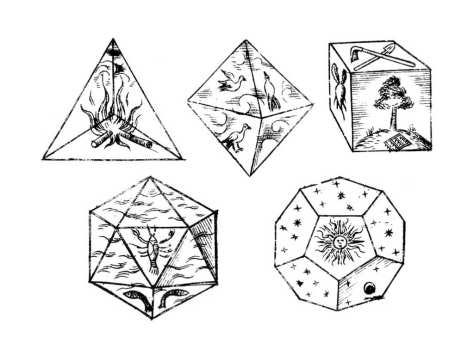
Words come from mental concepts, and mental concepts from universal forms abstracted from real things. But the intellect cannot abstract concepts directly from sensible objects. Rather, concepts are abstracted via phantasms—mental images stored in the imagination that spatially represent sensed objects.
For Aristotle, concepts cannot be conceived without phantasms. Where there is a concept in the intellect, there is a corresponding phantasm in the imagination. The intellect must continually “turn to” these spatial representations to think about concepts at all.
If LLM concepts correspond with human concepts, then just as Aristotle would predict universality across languages, he would also predict the necessity of spatial representation—given the coordination between concepts and phantasms.
And if words are artifacts of human thought grounded in sensible experience, then LLMs building concepts from these artifacts must build their own spatial representation. This is exactly what happens: vectors spatially represent concepts abstracted from words in an embedded space.
The ancients understood this connection. Plato’s Academy had “Let no one ignorant of geometry enter” inscribed above it. Boethius placed geometry before logic in the Quadrivium. They recognized that spatial representation and relational reasoning belong to the same order of reality—and large language models have accidentally confirmed their insight. How may classical metaphysics continue to reveal the structures of LLMs?
Related Articles:
Functional Teleology in Large Language Models
The Universal Language of Thought
An Aristotelian Introduction to Large Language Models
Interesting article, Mike.
One of the main intellectual challenges I’ve faced when dealing with the concept of an ‘universal language of thought’ is… what comes first?
The mental image, or is the word itself what gives meaning and definition to a mental image, especially when dealing with abstractions and emotions?
English, in my opinion, is better suited than Spanish to define certain emotions. You feel them in Spanish, but in English you have ‘akward’ or ‘dream away’ which don’t really translate well in Spanish but the emotions themselves become clearer when you define them with a particular world… and that’s when they become universal.