Delegating the Mechanical: Early Modern Information Management and the Lesson for AI
AI threatens the panache of the scholarly archetype. Recapitulating that archetype my save us from unnecessary mechanization of human activity.


The Proliferation of Note-Taking Methodologies
To enrich my commentary on AI, I’ve sought to draw from historical parallels.
Recently, I worked through Too Much to Know: Managing Scholarly Information before the Modern Age by Ann M. Blair (Yale University Press, 2010).
When the printing press came onto the European scene, scholars could gain an advantage by reading more widely.
Yet, the proliferation of texts could also cause the scholar to get lost in the sea of information. As Thomas Aquinas (-1274) encouraged Brother John:
Since you have asked me how one should set about to acquire the treasure of knowledge, this is my advice to you concerning it: namely, that you should choose to enter, not straightway into the ocean, but by way of the little streams; for difficult things ought to be reached by way of easy ones.
To navigate the journey to the ocean through little stream, early modern scholars became more disciplined in notetaking.
Marginal notes, commonplace books, compilations, encyclopedias, and other reference books flourished during this period.
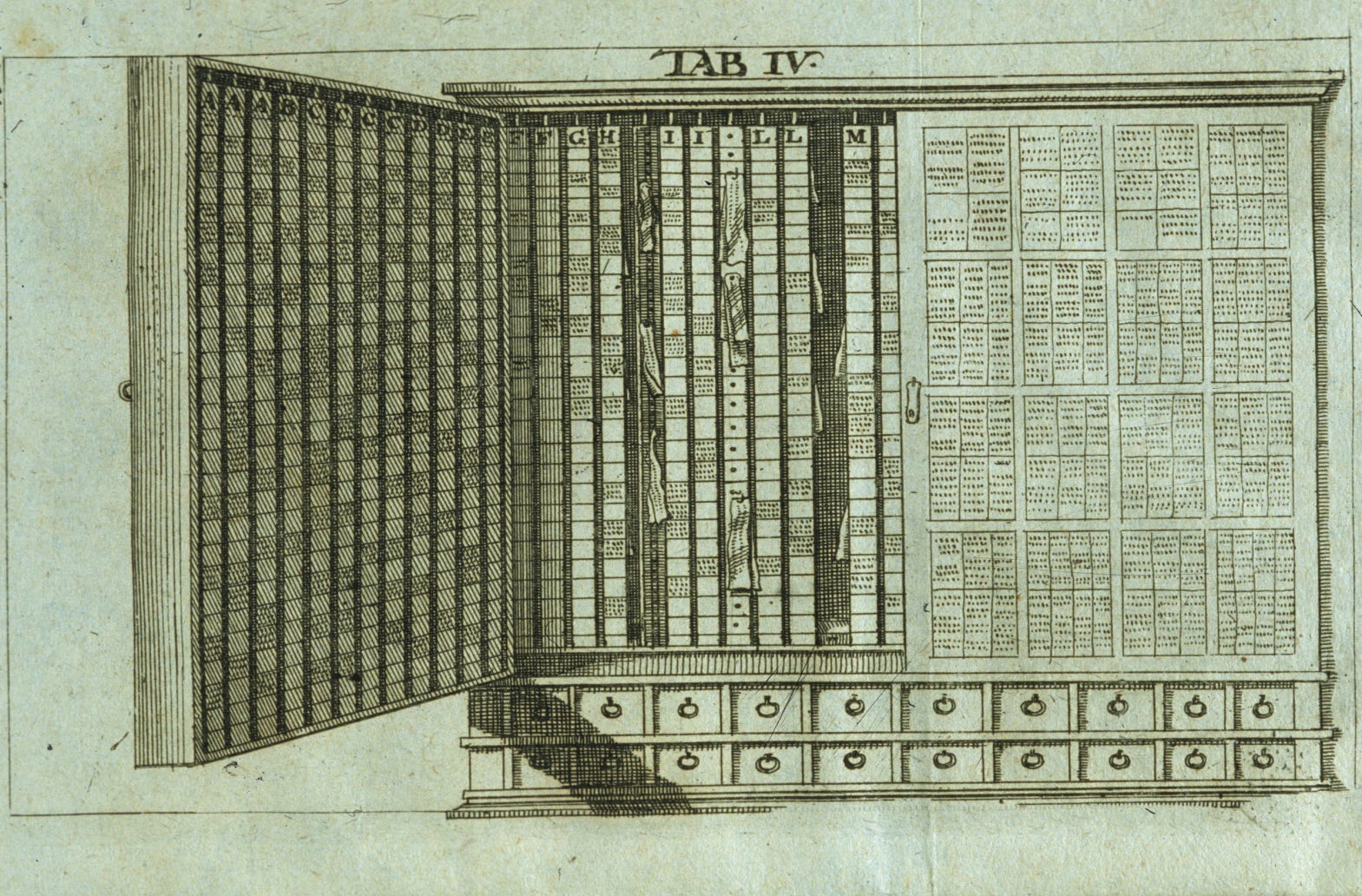

One of my favorites is Leibniz’ note closet. Leibniz took notes on slips of paper, and then arranged them by topic name.
Initially, this might seem neat but archaic. However, the implementation details around these methodologies is quite analogous with our integration of AI.
Identifying Mechanical Work
Many early modern scholars merely took notes and leveraged reference books to acquire vast knowledge without losing depth in primary subjects.
There were some professional readers who did the reading and the compiling of notes for another. (I’ve even written a short story that speculates what a factory of professional readers could look like when carried to the extreme.)
However, this was not common as scholars wanted to preserve reading as the noble, enriching act.
Some, like Leibniz, nevertheless saw “mechanical” steps in the note-taking process that could be delegated.
Copying marginal notes into slips and ordering the slips in the note closet were the mechanical steps that Leibniz was willing to delegate.
But the act of reading and categorizing topics required higher-level “judgment,” and that was worth preserving.
It fascinates me that this recognition of non-mechanical work and the unwillingness to delegate it away was so perfusive amongst the early modern intelligentsia.
I ask myself whether Leibniz would be amazed by the ability to leverage AI to delegate the non-mechanical—he could spawn agents to read, share, and organize research notes—or, whether he would be appalled that intelligence itself is becoming mechnical.
I’m inclined to think that there would be more to inform his judgment than research potential alone. The panache of the scholarly experience was no small part of his refusal to delegate non-mechanical work, and the intrusion of AI into that panache would be a primordial alarm.
Personal Level: Preserving Non-Mechanical Work
It would do us good, both at a personal and organizational level, to consider what constitutes “mechanical”, AI-worthy work and what work is non-mechanical and panache-preserving (all changes in custom since Leibniz aside).
Personally, I love the panache of the scholarly archetype, and so, I’ve embraced a very minimalistic use of AI:
If it is normative for my professional line of work to leverage AI, and I cannot compete without following suit, then I will use AI.
When I do software engineering work (my main source of income), I utilize AI.
When I teach (a part-time income stream), I don’t use AI in any part of the process. (It is not normative
When I work at Starbucks (another part-time income stream), I enjoy an analog day.
Since June, I’ve eliminated AI from my Substack writing process. (I used to use for checking my work, though I regret this.)
I don’t use AI for my graduate work—not evening for gathering recommended resources on a topic or grammar checking.
If AI is needed to establish a just relation, then I may use it.
The adoption of AI in HR workflows has resulted in taller list of required and preferred qualifications in job requirements—and AI systems tightly evaluate your application for these elevated requirement. To level the playing field, I will use AI to ascertain gaps in my experience and find resources for closing those gaps.
I suspect a similar phenomenon has emerged with legal documents. I will use AI to help sift through the bureaucratic text in, say, a refinanced car loan proposal.
Otherwise, no AI. I also have a heavy mix of analog experiences:
I print out most online article I’d like to read.
I tend an organic garden and take care of goats and chickens.
I teach at a classical school and work at Starbucks to get plenty of digital-free interactions.
I often involve my wife for feedback on my writing and ideas. I have other contacts that may do the same.
I read physical books and have a marginal note system. I don’t view the work of reviewing my notes and organizing them as “mechanical.”
I pause and think “is there someone local I could financially support to do this work” if I do want to delegate; or, I do the work myself.
A healthy first step right now is for people to reflect upon and be transparent about their delegation to AI.
Early modern approaches to scholarship can help us feel the limits of AI usage to preserve panache, serving as an archetype.
Thankfully, I was well-read on this archetype before AI—although I regret to say that my discipline in resisting AI delegation has not always been as strong as it is now.
But it’s added a lot of joy to overcome the delegation problem.
In short, we should be careful about making the joy of human learning mechanical.
Organizational Level: Preserving Non-Mechanical Work
The same applies at an organizational level in corporate America, even just the practical end of finances is in view.
AI integration has not been a smooth rollout. Not just at a psychological and ethical level, but with respect to maximal return on investment.
I suspect that treating all corporate work as mechanical has introduced more problems than it solves in some domains—beyond just the coordination problem.
For example, HR systems have used AI to optimize their workflows—but now we have a soulless process that’s stagnated the job application market.
Draining the life out of potential workers by presenting the job market as an abyss is hardly good for employers or the economy.
I’m sure my readers can multiple examples.
The Delicacy of the Matter
I feel the tension around AI, and I’m sure many of you do too.
I’m not one to be enthused by utopian visions of universal income. A future without diverse work for the exchange of goods reminds me of the grey town in Lewis’ The Great Divorce rather than anything sanguine.
I’m also highly concerned about worker displacement, though I’ve charted a path forward despite the challenges.
At the same time, AI is part of a global race toward national defense, cybersecurity, and economic advancement. It is here to stay even if it reminds me of Grendel—and, at times, I’d be content with a Beowulf to come slay it.
We may not be able to slay Grendel, but we can keep him at bay.
We can accept the economic reality that requires AI while also enriching our view of human work—and preserving panache—by not viewing humanity as inevitably mechanical.
Discussion about this post