Software Engineering is (At Best) Plateauing: What Should You Do?
Create an antifragile plan in case software engineering cannot be salvaged


Software Engineers Need a Backup Plan
Software engineering is plateauing.
The job market is volatile.
And applying for jobs has become an extremely brittle and frustrating process.
All because of AI integration—which isn’t going anywhere.
Don’t bank on an AI rollback.
And don’t let wishful thinking—which tells you that there’s still a need for software engineers—prevent you from taking action.
Anthropic thinks that software engineers can be replaced by 2027; the public thinks otherwise.
There is enough risk that any software engineer should assume Anthropic is right and create a backup plan.
I’ve gone through this process—and all the grief that comes with it.
I didn’t have the best backup plan in place. I got laid off in early 2025 as a shadow AI organization absorbed capital, and I’ve been trying to land on my feet ever since.
But I see with eyes wide open now and have solid advice for anyone preparing for the decline of software engineering.
Here’s What I Would Do
#1 - Recognize You’ll Need Resilience
That sounds platitudinous, but it needs to be said.
As software engineers, we are excellent at problem-solving, maximizing efficiency, and developing an ethos that cuts through bureaucracy.
And we are told that America is a meritocracy, rewarding workers based on their merits.
So, software engineers are likely to assume that the market will reward their skills and offer a panoply of opportunities—even when changing fields.
That may be true if you can connect directly with business leaders, but the HR machinery will filter you out.
They aren’t going to extract transferrable potential in your skills and experience; as of now, they will look for buzzwords and credentials, declining you if you don’t fit.
Given that, a software engineer’s backup plan will quickly run into the following:
Systems that haven’t adapted to reality of worker displacement driven by AI
HR isn’t going to see your cross-domain potential and accept your software engineering experience as an alternative qualification
There aren’t “micro-credentials” that can qualify you for another domain with little time investment
Job listings won’t go above their estimated salary range because you are used to a higher salary
People and organizations that won’t reward you as openly for your problem-solving, or worse, don’t want you to solve their problems in the first place
Lower paying jobs with higher professional standards
Example: A job at McDonald’s will have a dress code a software engineer is not accustomed to
In short, you will have higher expectations for what you can do and how you should be compensated than the market will offer you.
This dissonance is incredibly frustrating when you first encounter it.
But you need resilience. You need to accept these realities as they are, not as they should be.
I’m writing extensively on this topic to promote change. I’m not complacent. But I could save you a lot of trouble to avoid solving a macro-level problem that is out of your reach.
While you can’t solve the dissonance right now, you can create an optimal path within it.
#2 - Move to the Relevant Organization
If you’re not in an organization (or team) that is AI-forward, then you have an expiration date.
Try to make an internal transition to an organization/team in your company that is receiving investment.
Consider taking a pay cut and switching into a role outside of software engineering if it is AI-proof. It’s easier to make a career change internally than in the wild.
#3 - Save Money
Don’t expect a severance to completely cover you until you land a new job.
The more margin the better. Some savings is better than none. Don’t wait, and throw any savings into an online savings account or invest in stocks.
I’d aim to save 18 months worth of your current rate of pay. Better too much than too little.
#4 - Start a Consulting Business
AI is causing trust to decline.
When anyone can make a resume, for example, your resume carries less weight in an interview process. The ripple effect is wide.
Given that, consultants will have value even if they do the work that others can now DIY.
A small business owner is willing to pay for the trust that comes from you (an experienced professional) building the software.
While I think the risk of worker displacement is serious enough to write this post, I do think the remaining value of trust can be overlooked.
Some people’s trust will remain calibrated to pre-AI expertise. Plenty of small business owners will trust an experienced software engineer over an up-and-coming AI firm.
Take advantage of this window—the margins are great. Start a consulting business.
I recommend Book Yourself Solid as a good book for learning how to market yourself.
#5 - Consider a Flexible Part-Time Job in Hospitality and Food Service
Jobs in Hospitality and Food Service demand the soft skills that many software engineers are weak in.
The laid back ethos of software engineering is a perk, but you’ll need to change if you want to transfer your value into a new domain.
Applying analytical skills into physical work is also very satisfying.
The bar to entry is low, hours tend to be flexible, and there are some nice benefits.
Extra income, sharpened soft skills, and free stuff may be worth the 20 extra hours. Plus, you have a fallback that will anchor you amidst the volatility, and you’ll likely learn more than you expect.
#6 - Teach Part-Time
Similarly, education has a formality to it that a software engineer would do well to absorb.
Software engineers will enjoy teaching, and the formality (and dealing with kids) part will build your resilience.
#7 - Imagine a New Lifestyle
Trimming a budget means embracing a new lifestyle.
Seeing this is as an opportunity to master frugality, cultivate soft skills, and develop impenetrable resilience is not a detour for an entrepreneurially minded person.
Don’t do something you hate, and aim to do something you love.
You’d be surprised at how meaningful work that pays less will create a high quality of life you thought was associated with higher income.
A full pivot from software engineering into a less volatile and highly enjoyable field is worth the pay cut—but there is a baseline you’ll need to hit, and it’s going to require more work than you may be accustomed to.
#8 - Chase One of the Emerging Software Engineering-Adjacent Roles
I’ve intentionally kept this point last since I think many may jump to it first. I still think the previous points are worth considering even if this is the route you go.
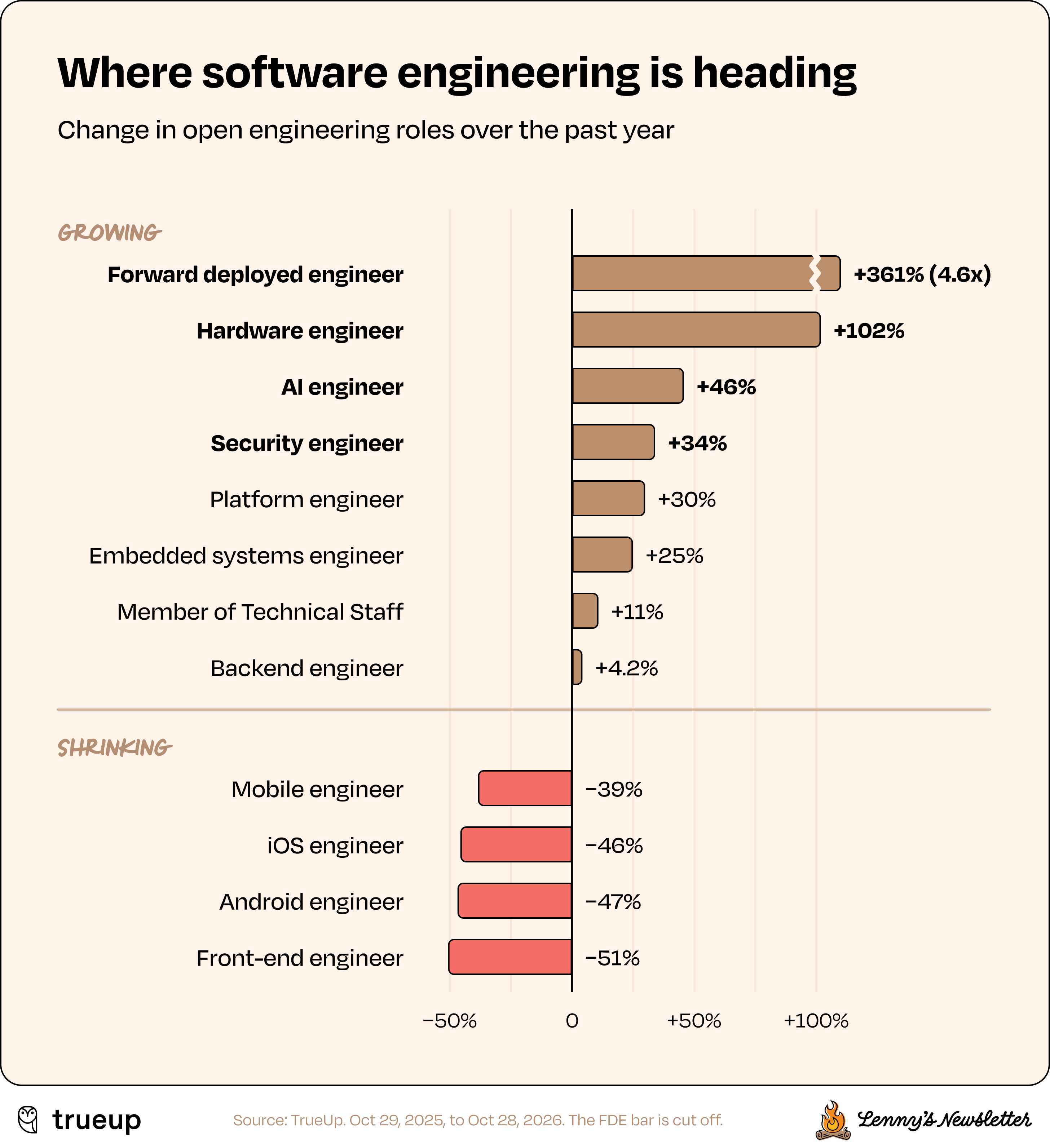
AI companies are growing more than the rest of corporate America, but they’re concentrated in San Fransico.
Unless you want to move there, then I’d look into forward deployed engineering, hardware engineer, or security engineering.
Product management has also been surface in these kinds of conversations, but I’d imagine it’s a harder sell.
In any case, you’ll need more than “I can learn this” or “here are some toy projects” to make the transition. And, again, when trust is low legitimate efforts in reading or small projects won’t carry the same weight as they used to.
Pursue formal opportunities rather than personal projects, even if it’s so easy to do personal projects right now with AI.
Software engineering is plateauing. It’s a weird time. But you do have options if you play your cards right.
Perhaps there’s a way to salvage software engineering. I’ll continue to think about that myself, but it’d be wise to have a backup.
Your point that HR filters look for buzzwords and not transferable skill is the part that rings true to me. Systems haven't caught up to displaced workers, so resilience ends up carrying a lot of weight. Thanks for writing from the other side of the layoff instead of from theory.