

Note: This is a simplified version of a research paper I wrote this past Spring—inspired by A Philosophical Introduction to Language Models and CS Lewis’ The Discarded Image.
Introduction: Revealing the Magic
AI is transforming business and culture at an extraordinary pace—catalyzing excitement and fear alike. Whether one instinctively reacts with “incredible” or “dreadful,” in either case, the suddenly-appearing power seems magical.
It is magical—but so are the powers within our own mind. Our minds abstract concepts from contact with real things, discover relations between concepts, and ascend to new conclusions through reason. Magical yet intelligible, Aristotle charted these mental powers long ago.
By examining large language models and our magical mental powers, we may see their parallels—parallels that were seen in the ancient connection between philosophy and geometry. In learning this magic, we may have a better foundation to summon a reaction to the AI-driven zeitgeist.
The First Act of the Mind: Understanding
Textual Experience
Underlying each tool is a large language model (LLM). During a training phase, these models are exposed to an enormous amount of digital content/data (e.g., articles, books, etc.). From a tabula rasa (blank slate), each model is able to abstract concepts from textual experience and form an inner vocabulary.
For example, when a model first encounters the word “dog,” it represents the term “dog” and the deduced definition (based on the context) it in its inner vocabulary. When further encountering the word “dog” in additional contexts, the precise definition of “dog” (stored in the inner vocabulary) can be fine-tuned.
Moreover, since many terms can “house” multiple concepts (e.g., mad = insane OR angry), the inner vocabulary of a model learns to associate an ambiguous term (e.g., “mad”) with multiple concepts.
In a very general way, therefore, we can say that LLMs abstract concepts from textual experience and forms a rich vocabulary.
Sensible Experience
This process has similarities and differences with Aristotle’s philosophical model that explains how the mind develops its intelligence.
There are three acts of the mind, according to Aristotle, that propel our minds to truth.
The first act of the mind, understanding, partially tracks with what was said above about LLMs and textual experience.
Through our senses, we encounter things. Encountering things via our senses produces a phantasm—a sensory image—which is stored in the imagination/memory.
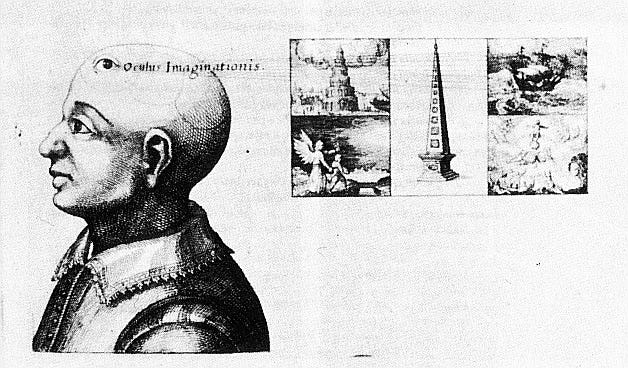
Then, our intellect actively works to abstract concepts from sensible experience (via phantasms), and these concepts are passively stored in the intellect.
Once a concept is stored, however, it still maintains a connection with the phantasms stored in the imagination. To think of “dog,” for example, requires the imagination to be activated—presenting the phantasm and activating the intellect to “see” the concept anew.
The dynamism (i.e., rich meaning) of each concept is likewise strengthened through experience, as the phantasm is developed from additional sensory input.
These mental concepts form the inner word, and the expression of words in language is but the “housing” of an inner word with an outer word (i.e., a term).
The inner words (i.e., mental concepts) are the universal forms abstracted from particular things. Although language allows for various outer words (i.e., terms) to “house” an inner word, the inner word (i.e., universal form) is a shared concept insofar as our sensible experience is shared.
Through sensible experience, we develop a rich vocabulary (both inwardly through mental concepts and outwardly through terms/words). Hence, words (and concepts) are derived from reality—from real things we experience through our senses.
Unlike our minds, LLMs do not have sense perception to experience sensible things. Nevertheless, they are able to abstract knowledge of real things by extracting concepts from outer words (i.e., textual experience).
The Second Act of the Mind: Judgement
Sensible Experience
With concepts formed, the second act of the mind is judgement. In this act, the mind forms connections between concepts.
More precisely, the mind takes one concept (the subject) and either affirms or denies that another concept (the predicate) belongs to it.
In the judgement, “Men are mortal,” men is the subject and mortal is the predicate. The judgement “links” the two concepts by “predicating” that mortality belongs to men. This is an affirmative judgement as it affirms that men (subject) are indeed mortal (predicate). The negative judgement would be “Men are not mortal,” denying that mortality belongs to men.
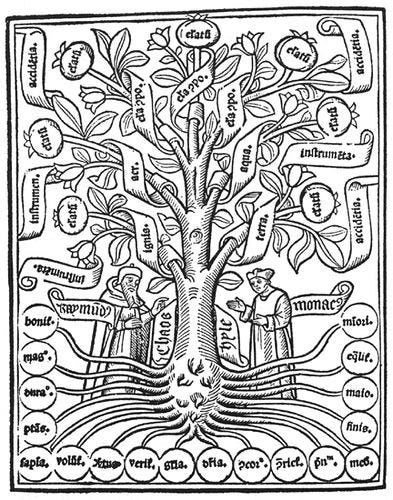
Truth is not found in concepts/terms themselves, but in the judgements formed when comparing and contrasting concepts. The mind attains truth, therefore, when it forms judgments that conform to reality (i.e., that are true).
Just as concepts have an inner/outer structure (inner word vs. outer word), so too do judgements. Judgements, technically, refers to the inner judgements—judgements within the mind. These inner judgements are expressed outwardly via language as declarative sentences.
Hence, we speak truly when our terms are clear (not ambiguous) and statements conform to reality.
Textual Experience
LLMs also are able to identify relations between concepts/words.
Unlike our minds, however, this does not come from direct experience comparing and contrasting real things. Rather, as a model only deals with outer words (i.e., concepts “housed” in terms/words), its comparing and contrasting is from textual context alone.
Still, a model develops not only a rich vocabulary of concepts, but an awareness of the relations between concepts as it compares and contrasts the subjects and predicates in various sentences.
Phantasms and Matrices
We mentioned above that our intellect receives a phantasm from sensory input, and from this phantasm, a concept is abstracted. Concepts cannot be thought about without activating the phantasm stored in the imagination. In short, concepts have a sensorial component.
However, for Aristotle, the movement of the mind to make judgements about concepts doesn’t produce a new phantasm to represent the established relation itself.
For LLMs, there is likewise a visual layer as intelligence is developed, and the visual layer only stores concepts (not judgements/relations) but necessarily visualizes relations. Let’s unpack this complexity.
The Embedded Space
Under the hood, the visual layer is the “inner vocabulary,” and is represented via a mathematical matrix. It is referred to as the embedded space.
Each concept is “visually” represented as a vector within the matrix/embedded space—a set of coordinates to distinguish one concept from another.
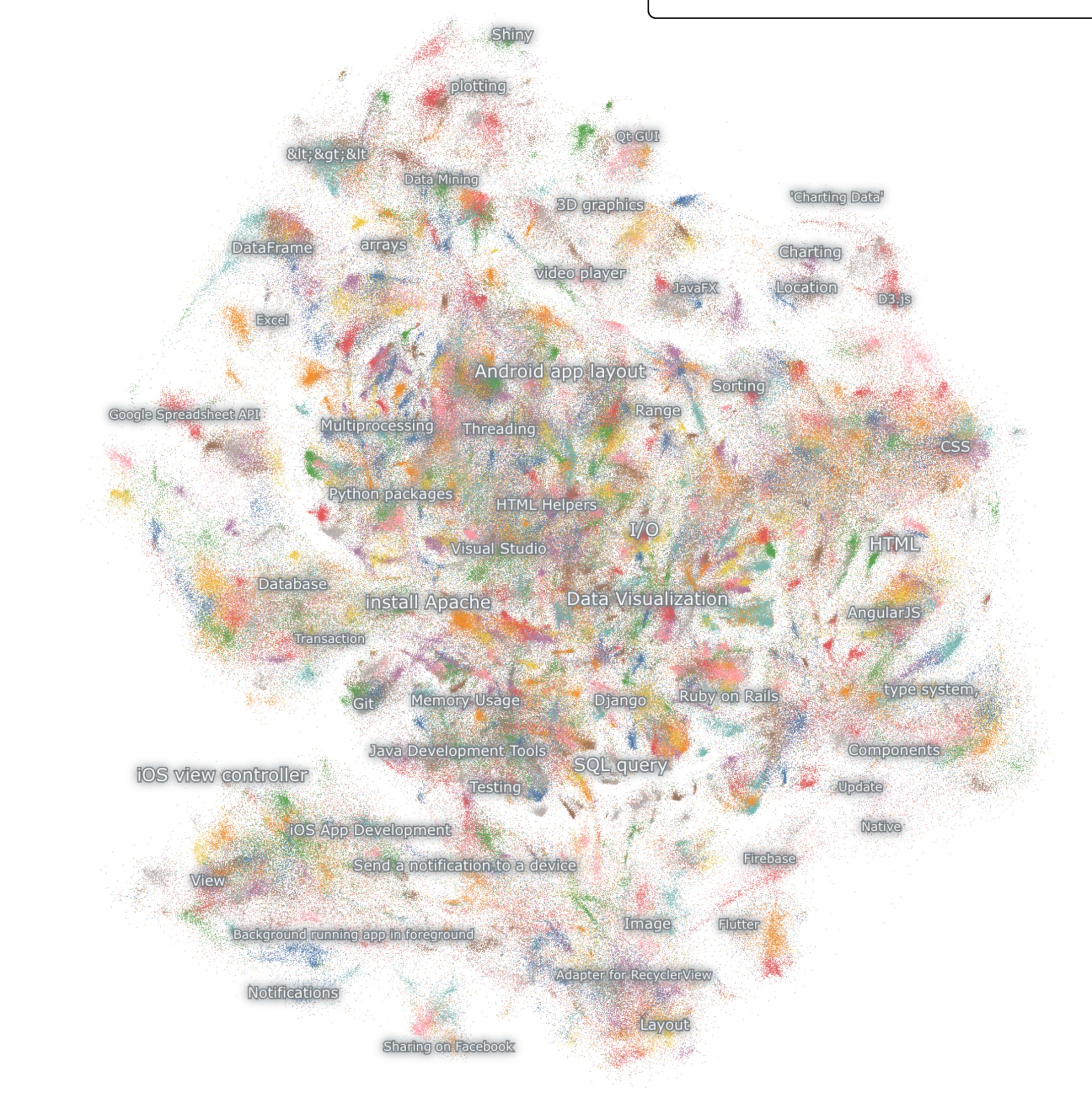
The vector itself does not store anything about the relation between the represented concept and another vector/concept—there are no coordinates to represent a relation with “queen” in the “king” vector.
However, since the matrix necessarily entails spatiality (i.e., it could be visualized as a multi-dimensional space), then the relation is in a sense visualized—viewing the embedded space would reveal a spatial proximity between “queen” and “king,” implying a relation.
However, the embedded space (i.e., the matrix) within the model does not have awareness of the relation during the training phase when the rich, visual vocabulary of a model is developed from textual experience. Where (and when) this awareness is actualized will be clarified as we continue.
The Third Act of the Mind: Argument
Sensible Experience
While the second act of the mind, relations are established between concepts via judgements, the third act of the mind, argument, refers to necessary connections between judgements—producing conclusions.
For example, if one judgement is “Socrates is a man,” and another one is “Men are mortal,” then the mind necessarily concludes that “Socrates is mortal.” The connection between these two judgements, leading to a necessary conclusion, comes from a concept that connects the two judgements.
In formal logic, the argument is represented in a syllogism:All Socrates is a man..
All men are mortal.
Therefore, all Socrates is mortal
The first judgement forms the major premise, and the second judgement forms the minor premise. Both premises are “linked” via a middle term: “men”.
If Socrates is a man, and men are mortal, then Socrates must be mortal—given what we know about men.
In a word, our minds arrive at conclusions, and there is a precise why that can be clarified through the science of logic as the three acts of the mind are formally expressed to evaluate the validity of our arguments.
Textual Experience
Here is where the differences between the human and artificial intelligence becomes most prominent.
LLMs are not able to reason—to sense real things, intuit essential and accidental similarities and differences, and understand why relations exist (and what necessarily follows these judgements).
However, LLMs can present conclusions (as any user can testify). How is this possible if only concepts are visualized in the embedded space as vectors, relations are not explicitly stored, and conclusions are neither explicitly stored not visible when viewing a visual, spatial representation of the matrix?
Here, we must introduce a key process in a large language model. So far, we have spoken of the training phase—the first process when a model develops a rich, visualized vocabulary by being exposed to lots and lots of text (i.e., textual experience).
However, the second process, called the inference phase, is when a model generates a textual response following a user’s prompting.
In brief, this process entails the model breaking down each statement or question in a prompt, identifying each word in a statement or question, and determining the meaning of each word.
By determining the meaning of each word, the meaning of the statement or question may be predicted. Once each statement or question (sentence/judgement) is known, then the broader argument(s) and/or questions may be identified. The model then can respond knowing what the user is communicating.
But, how does this relate to the embedded space (the visualization of concepts)?
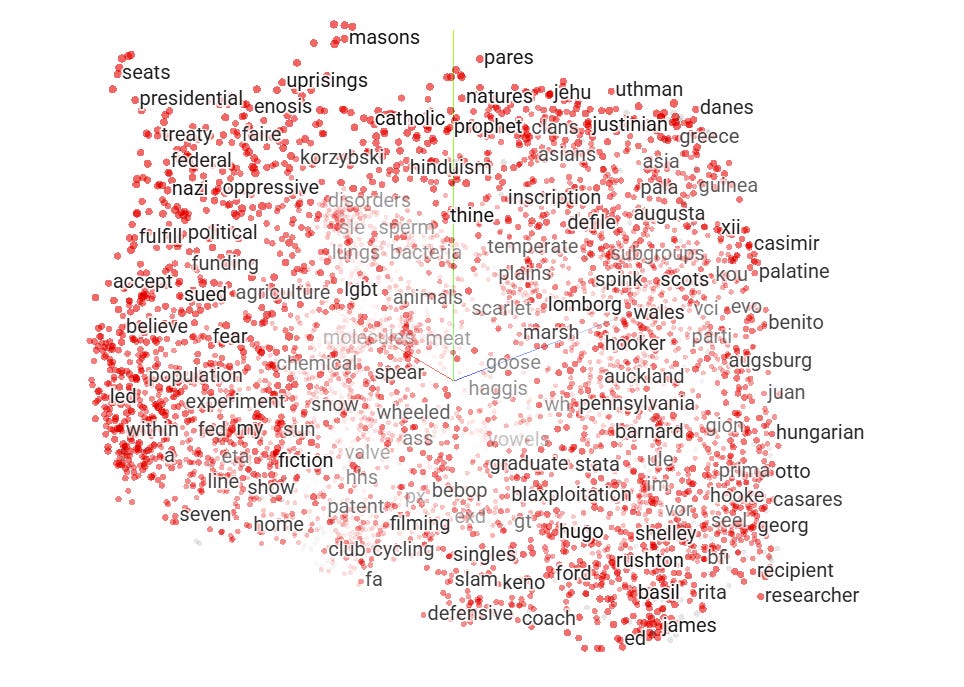
If each vector is a set of coordinates representing a concept in the matrix/embedded space, and the relation between concepts could be seen through spatial proximity, then then the relation between concepts could be seen in clusters, as various terms are spatially grouped together.
As mentioned above, an ambiguous word is an “outer” word that can “house” more than one “inner” words (or, concepts) in our minds (e.g., mad = angry or insane). When looking at a visualized matrix/embedded space, an ambiguous word would be spatially between multiple clusters. For example, “mad” would be between the cluster of words relating to anger and the cluster of words relating to insanity.
An LLM, like our minds, infers the concept being referred to within a prompt based on the context—but based on statistical analysis, not a imaginative-intellectual dynamism.
Unlike our minds, a model does not reason toward conclusions by identifying judgements and a connecting, middle term, within a prompt. Rather, it predicts what each statement or question means based on the constellation of concepts within them, and it is also able to compare and contrast the statement or question within the broader structure of the prompt.
However, since arguments are expressed in paragraphs, and paragraphs contain statements (judgements), and statements contain words (concepts), and concepts were ultimately derived from the writer’s encounter with reality, LLMs can succeed in understanding, judging, and arguing by virtue of their indirect contact with reality via textual experience.
Sensible Experience and Textual Experience: Similitude and Dissimilitude
Ultimately, LLMs are not humans—they do not possess reason. However, they can parallel the three acts of the mind identified by Aristotle long ago. Ultimately, LLMs simply give words geometrical representation and can understand sentences by comparing the constellation of concepts within a sentence with the constellation of concepts in its embedded space—the rich, (geometrically) visualized vocabulary derived from textual experience.
If Aristotle is correct that words maintain connection with real things, then LLMs are not entirely artificial in that they do encounter real things indirectly through words.
Moreover, if our words are the outer expression of inner concepts, and those concepts are connected with phantasms produced from sensible experience, then the presence of a geometrical layer in large language models makes sense.
To one committed to Aristotelian metaphysics, LLMs present a fascinating confirmation: intelligence requires both abstraction from particulars and geometric/spatial representation of relations. The ancients clustered logic, geometry, and philosophy in the liberal arts precisely because they recognized these deep connections.
But if we find ourselves in a modern world that has rejected Aristotelian metaphysics, and reduces the mind to mere computation, then exploring the why behind LLMs may unlock revolutionary potential to (re)discover the why within our own minds that transcends computation and points to metaphysical structures that unify being in an Ultimate Reality.
Large Language Models have accidentally presented to us a similitude with ancient metaphysics and the liberal arts—and their claims of transcendent structures and Reality.
From this, what shall we infer?
Related Articles:
Functional Teleology in Large Language Models
The Universal Language of Thought
The Geometrical Universality of Thought