

As security features, Microsoft introduced granular delegated admin privileges (GDAP). There are other examples of this. The idea is that customers must explicitly grant least-privileged access to Microsoft-service-providing partners. This implies that the secure approach is that the more risk of things going wrong, the less privileges assigned by default. Moreover, end users must explicitly consent to how they will be interfaced with.
Honesty, transmitted via standards of etiquette, has been foundational to any community. The internet is a sort of disembedding portal transferring one from a sense of time and place to a distinctively online world. Here, the stickiness of etiquette tends to evaporate, and the same disembedding quality makes the formation of such standards difficult to feel, popularize, and/or enforce. In this portal experience, subtle injustice becomes more frequent. I’ve written before on how disembedding portals are a feature of modernity seen in non-technical expert systems. We constantly have to transport to an abstract realm to deal with daily tasks. The internet is a particularly ubiquitous, abstract disembedding portal. My daily check of the email transports me to a system that far removed the sense of anything physical and proximate. In the soil of disembedding, accelerated by the internet’s success, new weeds in the garden of etiquette spring up: ghosting, rage-blocking, quiet quitting, and the like are invasive, subtle injustices. They are cop-outs to dealing with people as people, and fairly. The traditional words are cowardice and injustice, and they are fitting.
LLMs transform this phenomenon. Take ghosting for example. The subtle injustice is felt through the absence. LLMs allow for an absence through an abundance of text. It is not easily felt in many cases because it requires a movement of indirection that questions “Is this AI-generated?” Adding more indirection, one then has to determine how much was AI-generated, and then how much of it was reviewed. This will spill over from written text (e.g., email) into all forms of communication that is not in-person and instantaneous. In short, communication has the risk of things being done wrong (i.e. a subtle injustice) and no mechanism for users to consent to how they are being interfaced with.
This means that communication, especially online communication, provides the same criteria that drove zero trust security. The solution, then, is granular communication privileges. In communities, people will need to make explicit their method and approval for AI-driven modes of communication. Ideally, etiquette will extend into this realm, encouraging people to be transparent about how and when they are using AI in human interactions. People should press if the “privileges” aren’t made clear, and if it leads to ghosting, then the coward is exposed.
This, of course, still requires a care for justice that is not as sticky as the legal-financial consequences of security breaches. Perhaps, however, it would make the injustice not so subtle, and I hope this would have us to choose to treat breaches of the humane with a similar care.
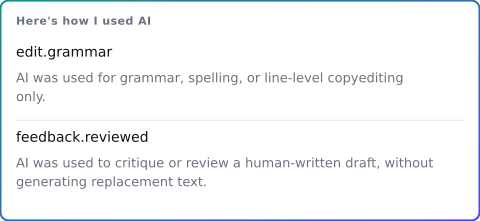
Note: To model my own suggestion, I wrote this full draft myself without AI. I then used AI to a first pass of feedback on the material, as well as grammatical/spelling mistakes. This led me to elaborate on my reference to disembedding portals and my previous article on it, and to manually add this sentence in the conclusion: “Ideally, etiquette will extend into this realm, encouraging people to be transparent about how and when they are using AI in human interactions.” I am still thinking about how/if to use AI for my various tasks.