

Recently, I have written about the standoff between the AI economy’s quest for a payoff—via accelerated AI integration—and the tacit (largely) resistance of corporate America.
Apollo’s finding that “no signs of AI payoff outside the tech sector” strikes me as more a reflection of that tacit resistance to integrating AI than a sudden discovery that the frontier overestimated the potential of AI to automate business intelligence. AI can automate business intelligence—the frontier is not wrong—but it cannot convince corporate America that the payoff outweighs the staggering risk of unemployment. It is this risk, I believe, that undergirds the misguided claims that AI is not capable of absorbing business intelligence.
This is why Anthropic reported in April that those “experiencing the largest speedups from AI express higher concern about job displacement.” Frontier AI hinges on the assumption that the better AI gets, and the me thoroughly it is integrated, the more people will be pleased; however, corporate America is signaling that it actually causes more nervousness about job displacement.
In short, the AI economy needs to solve the issue of job displacement before it can reach its payoff. It is clear that people will not integrate from hype and prophecy alone.
Moreover, the question whether AI integration is worth it, after ethical and economical factors are evaluated, is now being asked while the payoff has not been reached. Resistance is building in the public imagination.
If Anthropic’s pulse checks are on point, then people clearly want AI to augment their professional contribution—and not take it away.
The vibe shift in the public imagination, which took place in the middle of this year, is due to AI being so good that it is more likely take away professional development rather than scale it.
It would be one thing if AI merely shifted the work up one level and most workers could step into redefined workflows. Software engineers, for example, held out the hope that skilled prompting would create a clear enough point of demarcation to retain their value over non-engineers. However, we’ve seen many non-engineers become able to create sophisticated software as AI “injects” intelligence that the user doesn’t possess. AI doesn’t just write the code based on tightly-bound instructions; it can conjure code from a faint idea.
Seemingly, every hope of “judgment is still needed,” ends up a mirage as AI absorbs that layer. Even the complexity Apollo references of “accountability, trust, culture, unwritten rules, ethical trade-offs or fairness” can be easily embedded and extended by providing a simple text file to an agent without ongoing human involvement. With each absorption, less and less work is available for humans.
The only way to make business intelligence in humans perennially valuable is to limit AI from perennially injecting its superintelligence. More simply, if you want to retain human workers in the loop, then AI cannot take their place. If those human workers provide business intelligence, then AI cannot absorb business intelligence. Given this, AI was never on the trajectory to augment professional development—unless AI could create new work to allow fluidity into new roles. It was only a matter of time until people recognized the full power of the technology. While frontier companies like Anthropic are gaining new work, most of corporate America doesn’t have that privilege. For most companies, AI limitation be the only solution that bypasses worker displacement without bypassing the AI economy altogether.
There are two possible means of AI limitation.
First, there is the restraint on AI access. For instance, if you want to preserve software engineers, then AI must be restrained from writing code without a certain threshold of user intelligence being proved. This need not require some “prove yourself” test be baked into models directly. Instead, we can trust that roles map to a certain kind of intelligence and practical skills. Imagine access controls around AI where only software engineers within an organization can access the AI’s software engineering capabilities.
This shifts the focus from “integrate maximal AI maximally and adapt accordingly” to a much more conservative “integrate AI in a limited fashion by exposing only the capabilities proper to current roles/structures.”
A second, complementary approach would be to limit LLMs from “intelligence-injecting” capabilities. They may automate the means of executing a task proper to the role only when the user demonstrates that they could do it themselves. A non-software engineer, for example, could not generate code unless their prompting indicated they knew why this should be done and how it should be done if they had to do it without the automation.
Combined, these two limits would make AI interaction much more like using a tool that enhances productivity instead of absorbing intelligence. We can’t all have our cake and eat it too. While technology plagues us with short-term memory, spoiling us so easily, AI with these limitations would still be a productivity gain compared to a pre-AI era—yet it would avoid the chaos that maximal AI integrated maximally is causing in the present.
Until such a limitations exist, AI is on the trajectory displace non-technical corporate workers if the will to integrate it exists.
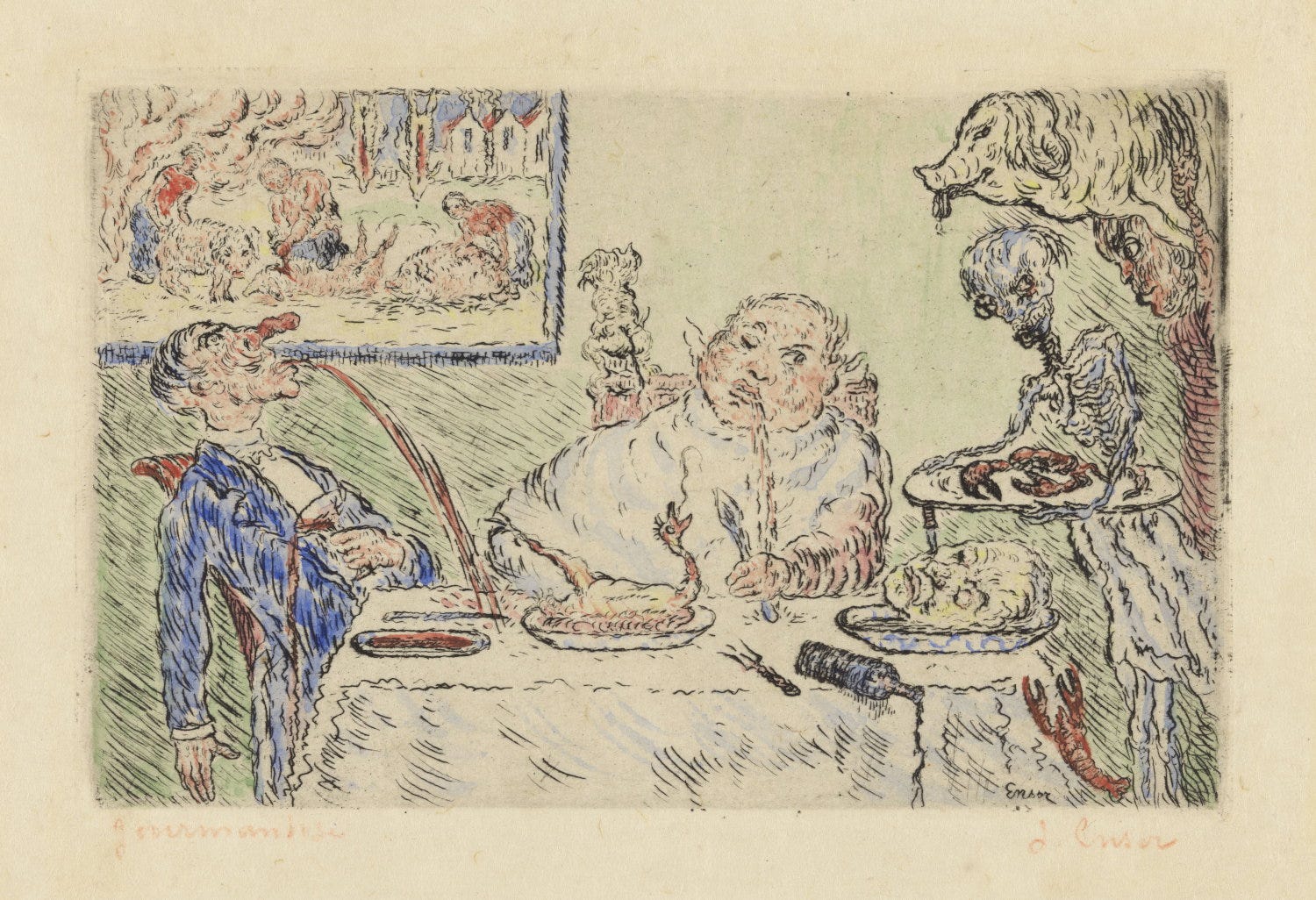
Limiting technological advancement go against the grain of the worldview of the silicon sages that see disruption as a metamorphic force. This “spirit of disruption” does not have to be so, however. Perhaps we are finally recognizing that philosophy must come first to inform the final cause of our technology; and, good philosophy may tell us that limitation can be good—for gluttony, even technological gluttony, is sin.
Michael a text file can hand an agent a lot of judgment, I agree… although someone had to know what to put in it. I'd rather that file belong to the person who wrote it than to their employer or one AI company.