

He awoke, and he was not at home. His entire horizon was surrounded by a lovely and homely orchard. The air was crisp and flowers bloomed. There were enough rows of fruit trees to feed a family and a modest surplus. As he approached the nearest tree, he noticed something was off. He was sure that the fruit was a McIntosh apple, yet an orange blot. He checked the others, and they, too, were cosmetically tarnished. With the gentlest tug, he picked a ripe apple, took a bite, and savored what was a very pleasant apple. As he walked around the perimeter of the tree, he also observed that the tree was remarkably productive. Examining several other trees and rows, he confirmed that the phenomenon was manifesting across the entire orchard.
He was a hard-working man, and he had perused excellent books from successful and honest orchardists. The orchard meant much to him. He took care of it, and it took care of him. He never could make his orchard as pretty and productive as his textual mentors, but it was good work nevertheless. He didn’t like to overly fuss with things, and perhaps he missed some needed attention-to-detail as a result. So when he saw the orange blot in combination with abundant fruit, he assumed that it likely was from the microbial effectiveness of his improved compost—a blemish worth overlooking giving the taste and, arguably, a rustic mark emanating from rustic care.
The next several days, he cared of his fruit trees; apple, pear, or peach, each tree was porous toward the honest work. He also took inventory, steadily gaining much excitement to analyze the final numbers as each tree offered the thrill of marking so many tallies. In his storage shed, he sat down at a humble desk and evaluated how much fruit he could sell. He couldn’t believe his eyes, but he could sense his raised spirits, for his calculations suggested that he could fund his dream of building a cidery from just a month of sales.
Friday afternoon, he prepared his goods, bushel by bushel, crate by crate, and label by label, and loaded them onto his trusty, blue and white F-150. The next morning, he drove on the rugged path in the woods, arriving at a pavilion at the edge of the woods and bordering the town center where vendors would often sell goods. He unloaded his truck, prepped his stand, and felt the rush of being on the verge of launching his cidery. By nine, the pavilion was flooded with vendors. Many had also used bushels, crates, and labels to have apples to sell. All of their apples had the same orange blot and the same taste. So much for the cidery dreams.
Throughout the next week, the man iterated through ideas for gaining an edge at the market. At some point, he landed on making applesauce, since that would require incorporating additional ingredients in which no orange blot could be found. With bushels, jars, and labels, he distributed the toasty, aromatic applesauce.
On Saturday, he made his way to the pavilion with renewed hopes of a cidery. It was as if the fulfillment of his dreams for a cidery, which had always been a pleasant yet distant aspiration, was now a tangible object that would either invigorate if clutched or devastate if missed. Momentarily, he had forgotten the dignity of his labors prior to the orange blots; for while the abundance of apples had increased potential yields, it also increased the demarcation of success. With jars and labels, he laid out his table. But to his great disappointment, the morning filled in with an abundance of vendors who likewise had the idea of gaining an edge by transitioning from mere apples to applesauce.
The man was not the only one disillusioned by the turn of events. One of the other disappointed vendors returned to his property and felt a deep longing for either the new abundance to yield a return, or for the aspiration to be back in the shadowland of “what-if.” He was different than hard-working orchardist; it is difficult to put it into words, but his labors, and really the scenes of his life, were more transitory. Examining his small orchard and deep in thought, something in the corner of his eye caught his attention. At the far end of the orchard and next to a compost pile, there a round structure that he couldn’t fully make out.
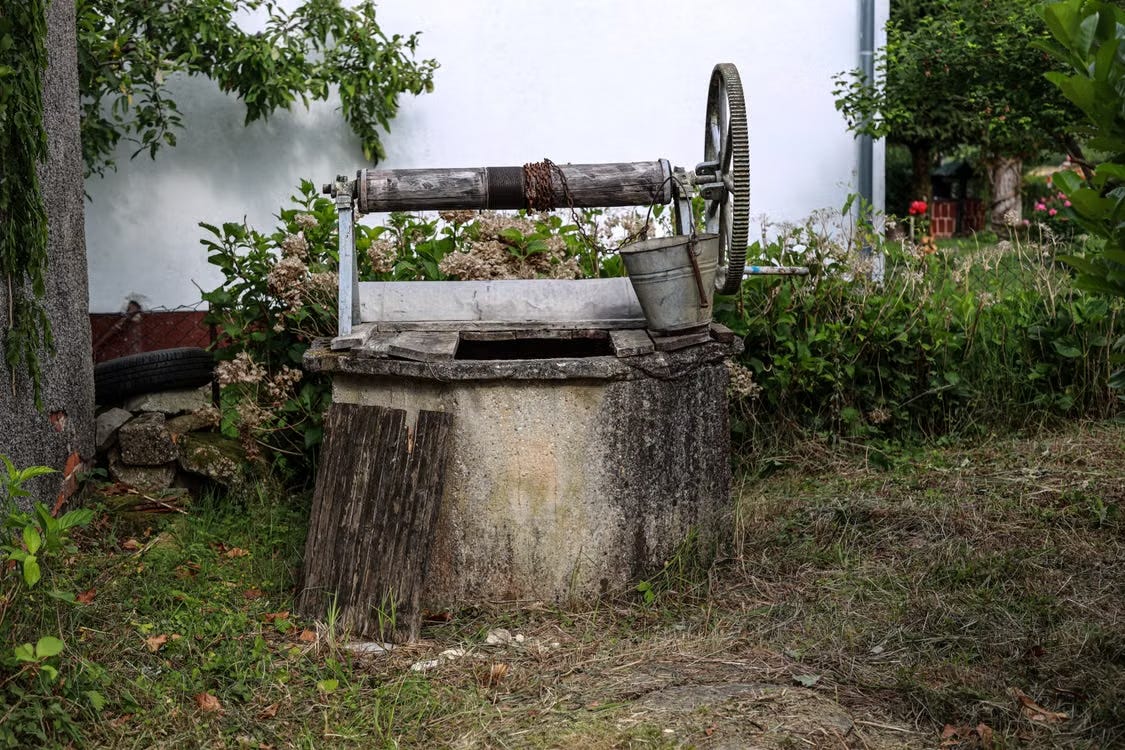
Upon inspection, as he cleared the brush between it and the compost pile, he saw that it was a cistern composed of stone blocks. He stooped over the hole and saw that it was full to the brim with the clearest water which cast a reflection of himself. A strange phenomenon took over like the emergence of fog on an Autumnal morning. He felt drawn to enter. He was overwhelmed by the thought of the newfound abundance finally yielding its fruit. He had never felt more clever, more near to a breakthrough, and more ready to dismiss his former views. This whole time he and the other vendors had been trying to distinguish themselves to clutch their aspirations. But what if the abundance could be combined and the yields shared should their goods be sold somewhere else altogether? (He was not aware that the orange blot phenomenon was spreading everywhere.) Perhaps his hopes were not dashed, and the orange blot had indeed turned things toward an unfathomable better. There was no going back. He must adapt, and he was ready to enter. He dipped his hand, now crustier than before, into the water. He did the same the other; then, he dove headfirst, sinking like an anchor into the abyss.