

There is a lot of buzz around the research papers, models, tools, and orchestration workflows around agentic workflows. It is exciting, but it also means we can get lost in rabbit holes. Every rabbit hole feels momentous because there are still so many unknowns and gold to be mined. By stepping back, we see clearly what is happening across this landscape at a high level. Specifically, I want to focus on the landscape emerging in the software engineer to agentic engineer migration.
I suggest introducing three terms to help clarify the kinds of work being down across this landscape.
One group of workers are the researchers. These are people focused on forming granular insights about agenetic workflows. This happens at a popular level, but it is most concentrated in academia or academia-adjacent circles (e.g., Google DeepMind). This group is examining how to interpret models, how to improve model architecture, how to evaluate the differences between small and large models, evaluating how prompts and agentic workflows impact output, providing a philosophical explanations for AI, et cetera.
Another group of workers are the explorers. These are people focused on exploring tools and workflows apart from a company-driven / product-driven problem space. This includes exploration work like building RAG layers, maximizing MCP tooling, testing the LangChain ecosystem (and other orchestration and evaluation tools), et cetera. This work tends to emerge from personal projects / thought leaders and tooling companies / projects. An example would be someone charting the course for using Figma Console MCP.
The third group of workers are the stitchers. Think of a company that takes their existing software teams and gives them the time and capital to invest in building out agentic workflows. Stitchers focus most on building of the insights of explorers, stitching together tools to form a cohesive workflow for a company / product problem space. For example, a large company invests in their existing design system team to create an agentic workflow that builds a new, highly efficient workflow to produce design system artifacts.
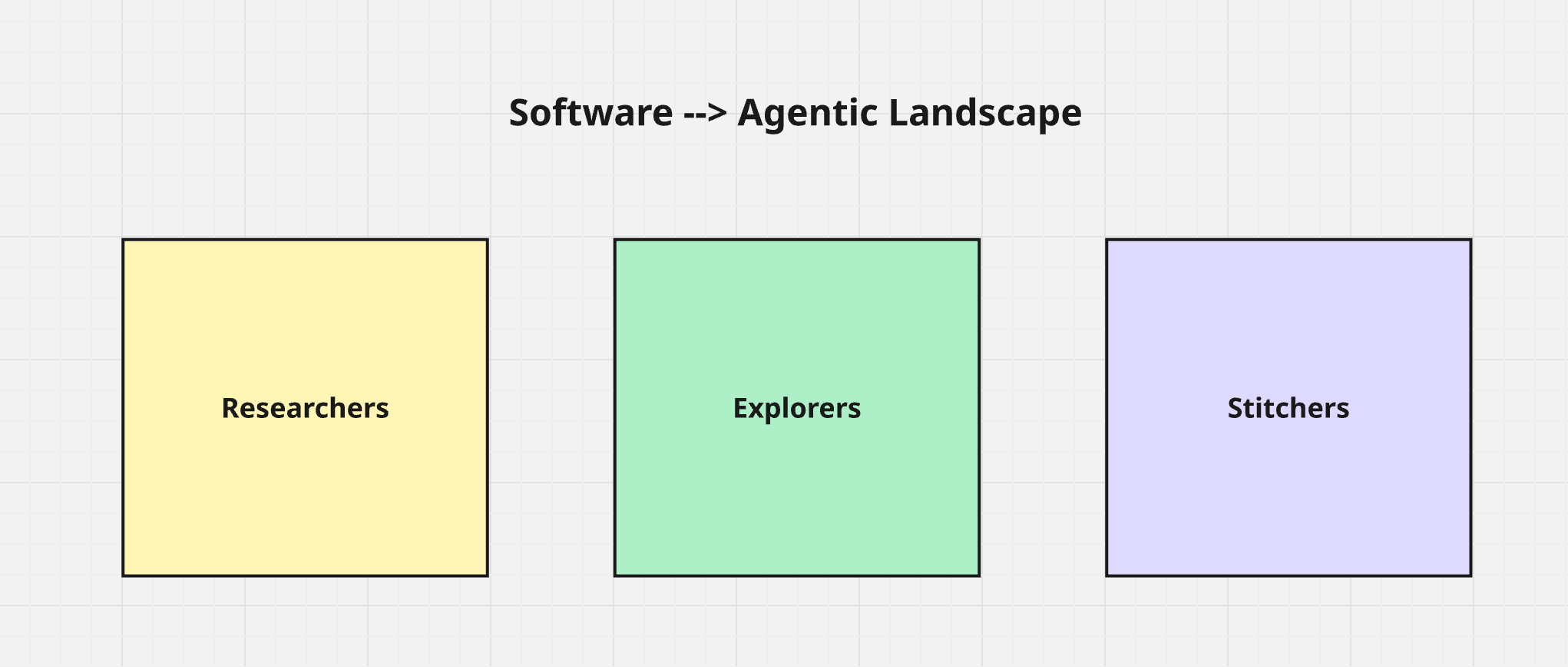
There is fluidity between the researchers, explorers, and stitchers.
Explorers can update their general tools and workflows based on emerging research and the feedback from stitchers.
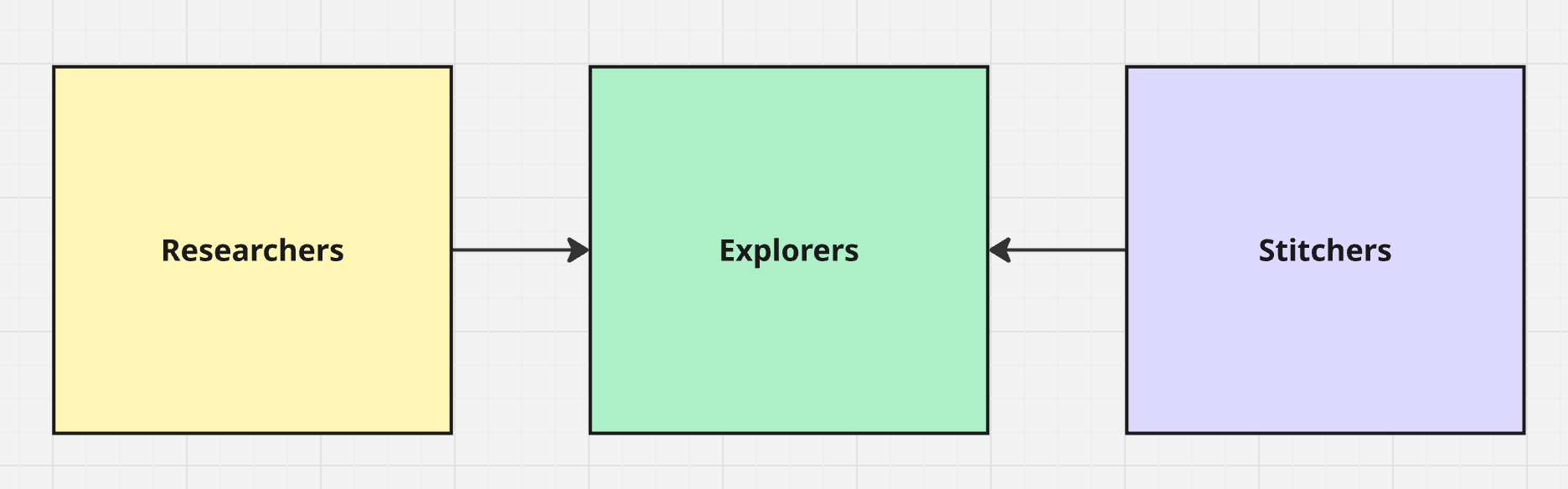
Researchers are presumably the most autonomous, being furthest removed from a corporate problem space. However, the aspirations of explorers and stitchers can inspire new research projects.
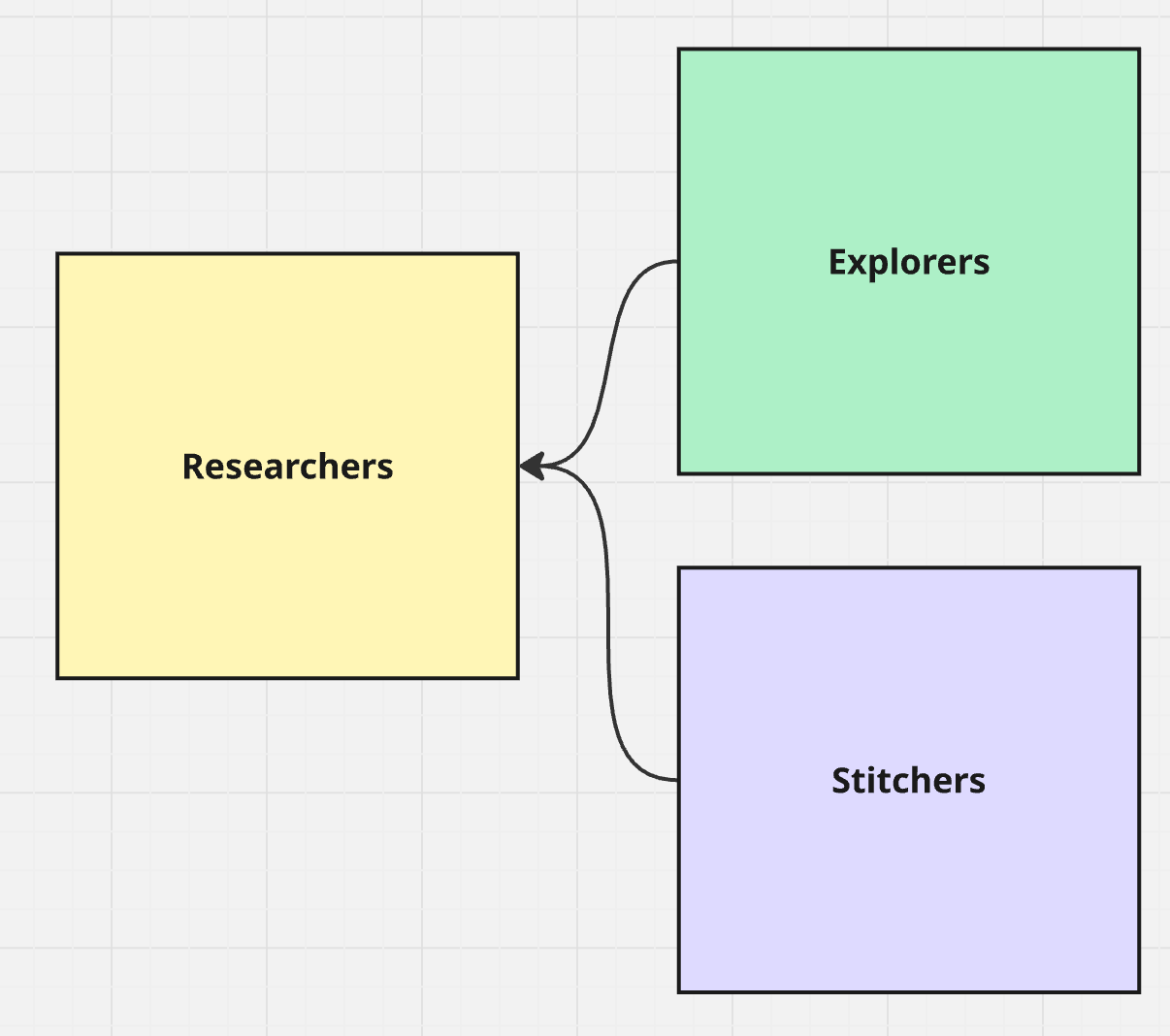
Stitchers are presumably the furthest removed from research and rely the most on explorers. They need tools and workflows to stitch together for a company-driven / product-driven problem space.
This captures the dimension of kinds of agentic work, but there is another dimension worth capturing.
There is also a spectrum of how institutionally-sticky a kind of work is. I suggest a pet-to-institution spectrum to explain this.
Pet projects emerge from individual interest aside from an institutional context. For example, a stitcher may be exploring some tooling and blogging about it as a side project.
Institution projects emerge from structures with capital that are willing to invest in innovation. A corporate company may be willing to invest in a design systems team that can create their own agentic workflows. Universities might sponsor research into LLM architecture, for instance.
In between are community projects, things like open-source projects, pet projects that have gained community sponsorship (e.g., TanStack), websites/applications that seem formal but may actually just have a very small team behind them, et cetera.

If I had to guess, the researchers, explorers, and stitchers have these kinds of relationships with the pet-institution scale:
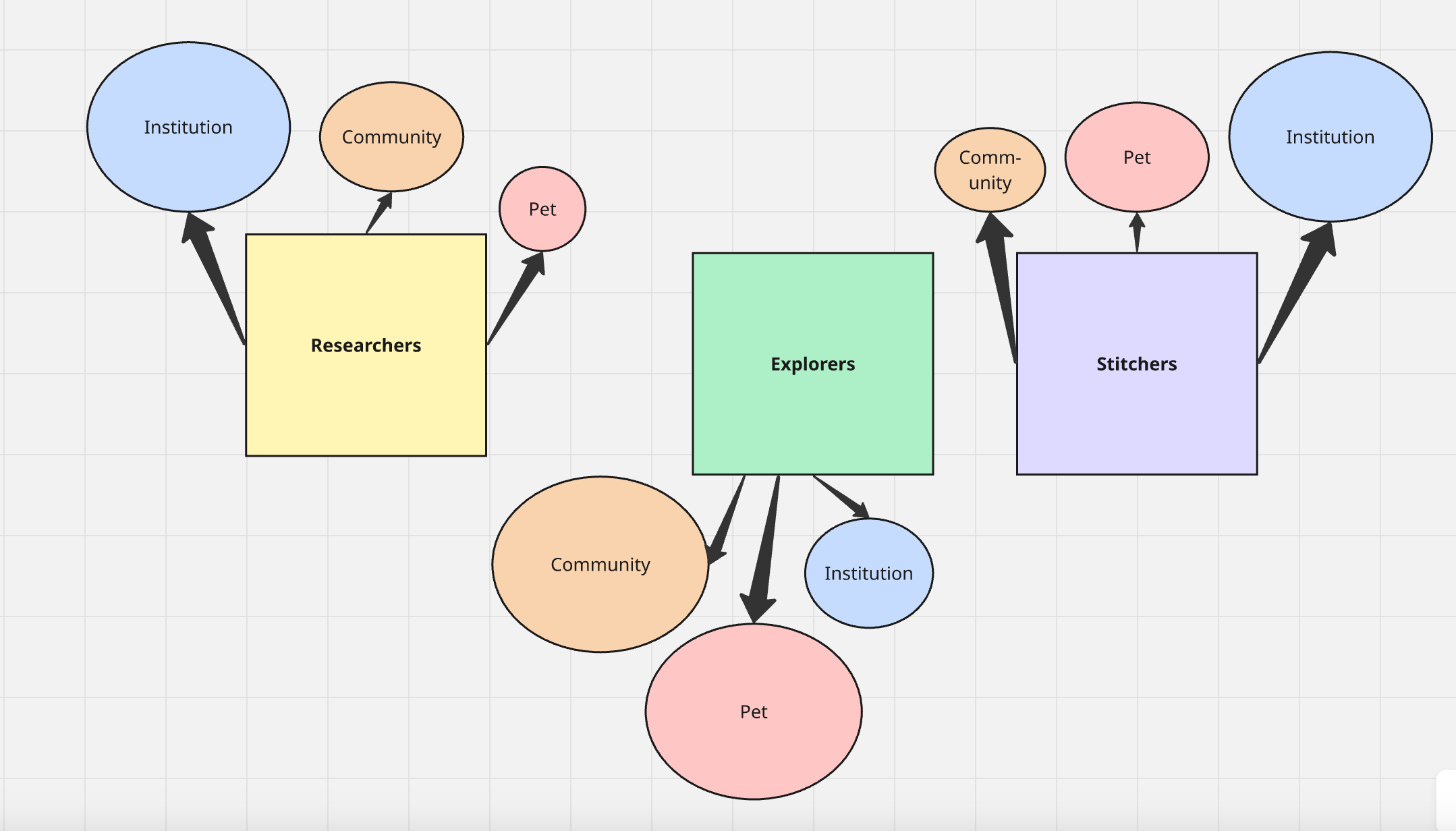
Meaning, researchers and stitchers are the most likely to reside in institutions; explorers dominate the community and pet space; researchers are least likely to do pet projects since research requires sponsorship to get off the ground (whereas explorer projects can grab more attention from a prototype by creating shareable content); and, stitchers will likely pursue pet projects, since people want to develop an online presence outside of their corporate / product contexts to gain get ahead of potential shakeups.
You’re welcome to grow and shrink these circles based on your observations, but hopefully this helps make visualize the phenomenon.
Now, it’s worth asking how this landscape compares to pre-agentic one. You likely could have drawn a similar graphic to represent the pre-agentic software industry. However, research has come into much closer contact with the explorers and stitchers than in times past. Moreover, there is much more hype that explorers can create standalone projects since agentic workflows expedite the software development process (among other things). Institutions also have become much more like financially-backed exploration labs. Exploration labs used to be original to large, creative companies like Airbnb, GitHub, et cetera. Now, I presume many corporations are willing to invest big in AI and create internal exploration labs that wouldn’t have received the investment previously.
Most importantly, there is much more fluidity to move across these kinds of work. A stitcher can write a research paper, and a research can build a product. Because fluidity has increased across these kinds of work, it’s as important as ever to grasp the bird’s eye view as boundaries become more blurry. If we don’t, then we can easily run fast in a direction.
By visualizing the full landscape, we can make more informed decisions about where to invest our efforts, how to network with those doing different kinds of work, and what content to prioritize digesting.
In future articles, I’ll explore how bird’s eye topology may inform what kind of agentic work has the most value in this landscape.