


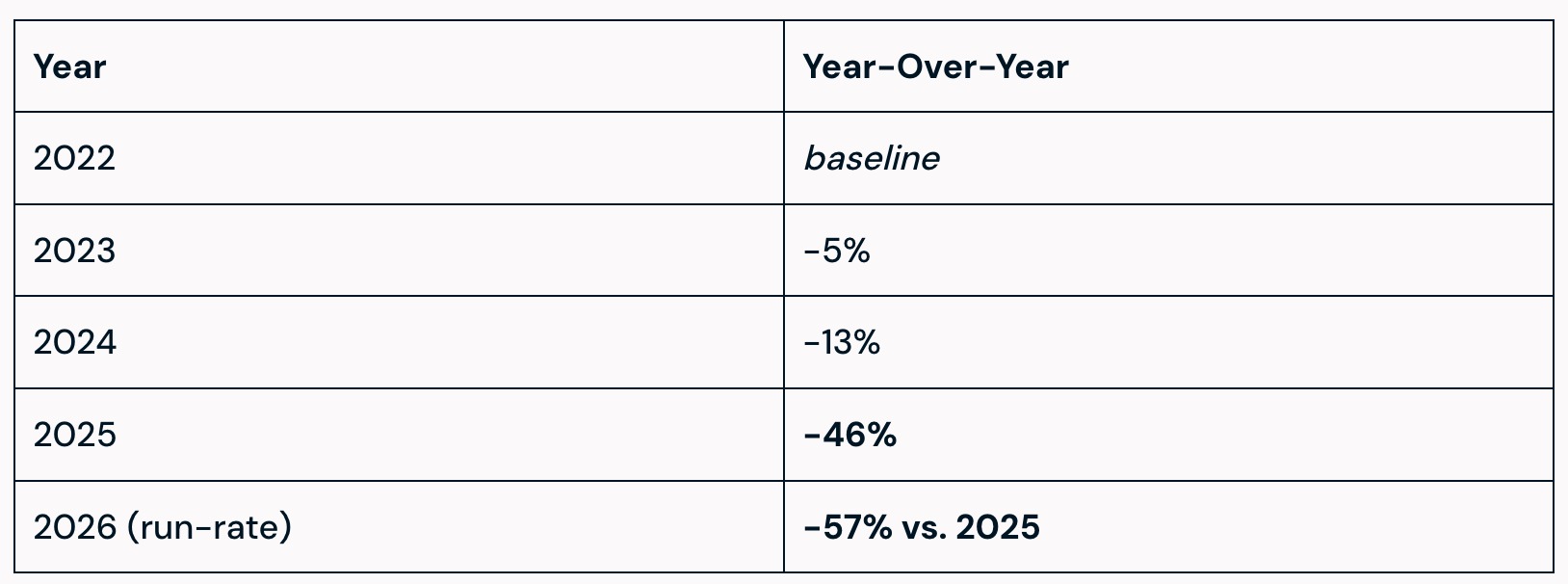
Tim Ferriss wrote that AI has effectively killed prescriptive non-fiction. He cites his declining book sales since the advent of LLMs:
He does clarify that some prescriptive nonfiction may survive:
Experience that isn’t solely information: comedy, entertainment, storytelling, fiction, etc. You don’t ask an AI to summarize a stand-up special, and a synopsis of a great novel is not a great novel. Voice, taste, and personality may end up being the only durable moats. But “give me the 5 steps to X”? That’s a tough business that’s about to get a lot tougher.
I think there’s more complexity to this. AI accelerates information generation and information broadcasting. It also accelerates information retrieval. I don’t think all three accelerate at the same rate. Tim Ferriss published books like The 4-Hour Chef that aggregated immediately-actionable information. Immediately-actionable information is shallow. His books were deep with information. I mean that at least some part of his books could be applied immediately, without friction. Possessing mastery over cooking is no joke, for it requires much dedication and the accumulation of expertise over time. But the friction to simply start cooking a meal is relatively low compared to other domains. AI has clearly usurped this kind of information gathering and broadcasting.
The same cannot be said when a quick retrieval on a subject still leaves you far from being able to practice it. If I asked Claude about the history of classical philosophy, I would get answers far more swiftly than if I had to retrieve books—even information-gathering books like Ferriss’. But with a subject like that, demonstrating real mastery feels far off. For that, you’d have to keep prompting — pushing further and further into the subject. At some point it gets hard, and the availability of information stops being the barrier. In short, information that causes intellectual friction demands a skill AI can’t give you.
This gets more complicated still. AI provides you greater breadth of low-friction information, giving people a sense that they have gained much. However, many people are making equal gains. The differentiator will be people that can either synthesize connections across that breadth, or push past the friction point where many would stop.
This is nothing new. There have always been intellectually-demanding subjects. However, AI “pushes back” the friction point. For example, writing software was a high-friction task for the average person, but AI can now do this quite easily. Mastering the principles behind architecting agent organization is now the level where the friction comes. The point is that pushing through intellectual friction is still valuable, though it’s moved “further back.” Whether this remaining value translates to equal employment opportunities for those that “level up” is another matter.
Interestingly, while AI can leave people thinking they’ve made deep gains that are actually shallow, it can also produce the opposite effect. Some people use AI to go well beyond the typical user. However, there is no obvious indicator when you have reached this stage. We can call this the breakthrough-feedback abyss. It’s the gap between making real intellectual gain and having any signal that you have. For example, before AI, my ability to write working software would intuitively signal that I’ve gained ground many hadn’t. However, prompting deeper into a subject than most people would be willing/able to doesn’t come with an intuitive signal.
AI fluency is an attempt to solve this experiential dilemma. I’m not sure that it is a viable one. While I did take an AI fluency test to serve as a microcredential, I still think its a bit smoke and mirrors. So long as we don’t know how our prompting impacts the outputs of the LLMs, then it is hard to determine our fluency. Moreover, these fluency tests leverage LLMs themselves to judge fluency, which is circular. Having access into the impact of our prompting on LLMs would be very helpful, but moving away from the squishiness of “fluency” is a step that can be taken regardless.
Another response might be that we can evaluate our advanced abilities through what we produce, but this shifts the problem since what is being produced is equally saturated as information. Or, we’ve accumulated knowledge that doesn’t have an arena to be tested in.
I do think there is a solution that addresses both the concern about prescriptive nonfiction absorption and the breakthrough-feedback abyss. To get us toward that solution, it’s important to ask if there remains value in an information-gatherer like Tim Ferriss. Absolutely. Aggregating information remains highly valuable if you have authority. The more that AI-accelerated information saturates, the more useful it becomes for someone to just tell us what is remarkable and what is noise. Even if AI could automate this kind of process, trusting insights from authority is lower friction.
After reading Tim Ferriss’ article, I immediately signed up for his 5-Bullet Friday newsletter. I trusted that if he’d cracked the code on packaging gathered information before AI existed, and now had an astute read on AI’s trajectory, then his top-5 picks each week were worth my time. Gathering from authority figures that have earned my trust through breakthrough, and are finding gems amidst the sea of information, puts me at an advantage over others trying to filter on their own. Even if AI could do this, it wouldn’t earn my trust the way an authority figure can. Trusting the human authority will restore my sense of breakthrough, and that will be valuable even if their edge is merely perceived. Humans aren’t merely higher-computing agents. They can convery having gone through friction in a way an AI can’t. Tim Ferriss can coast on the authority he built before AI. Otherwise, you’ll need to break through in a valuable domain yourself and demonstrate higher-quality judgment to become an authority.
Escaping the breakthrough-feedback abyss also requires a human authority. Once you find an authority figure for a subject you are interested in, you can compare your depth of knowledge with them. If you are able to keep pace with them, then you now have a benchmark that you’ve made a breakthrough, without any fussing with AI fluency ratings. Should a shorter-term benchmark be needed, I suggest reflecting on your ability to push through when you encounter intellectual friction. Building this habit will give you an edge, and not everyone will gain it in the AI era.
In summary, AI can absorb participatory nonfiction; aggregating and internalizing high-friction information still requires skills AI hasn’t fully absorbed. Pushing through high-friction information, and benchmarking yourself against trusted authorities, gives you the feedback signal for breakthrough that AI can’t replicate.