


In my Part 1, I began what is effectively an extended footnote on my research paper draft: The Celestial Mirror: How Medieval Cosmology Reveals the Architecture of (Artificial) Intelligence. Specifically, we saw that Aquinas defines a soul (animus) as a living thing that possesses self-initiated movement toward an end goal. Such a thing is animated (from the Latin animus which means soul). Humans, animals, and plants are all marked by self-initiated movement toward and end goal. Hence, there is a human, animal, and vegetative soul—each with their own set of powers. Humans are rational animals. They possess the powers belonging to the highest animal and the vegetative souls, as well as the distinctive powers of understanding and willing.
Given this definition of soul, an LLM cannot be classified as a living thing. They operate according to a design externally imposed—not a self-initiated one. Yet, they can process information dynamically, generate novel outputs, simulate cognitive operations, and learn patterns from training. These features appear to be effects not only of a living thing, but of rationality. Nevertheless, I asserted that an LLM may be categorized as:
Human artifacts that accidentally possess internal sense powers geometrically, and through these accidental, geometrical internal sense powers, they possess a quasi-yet-effective-reasoning.
In this post, we will unpack this technical definition—which in turn helps to unlock the key to understanding the black boxes of LLMs.
Sensorial Powers
Sensorial powers emerge in the animal soul, and hence, are possessed by the human soul
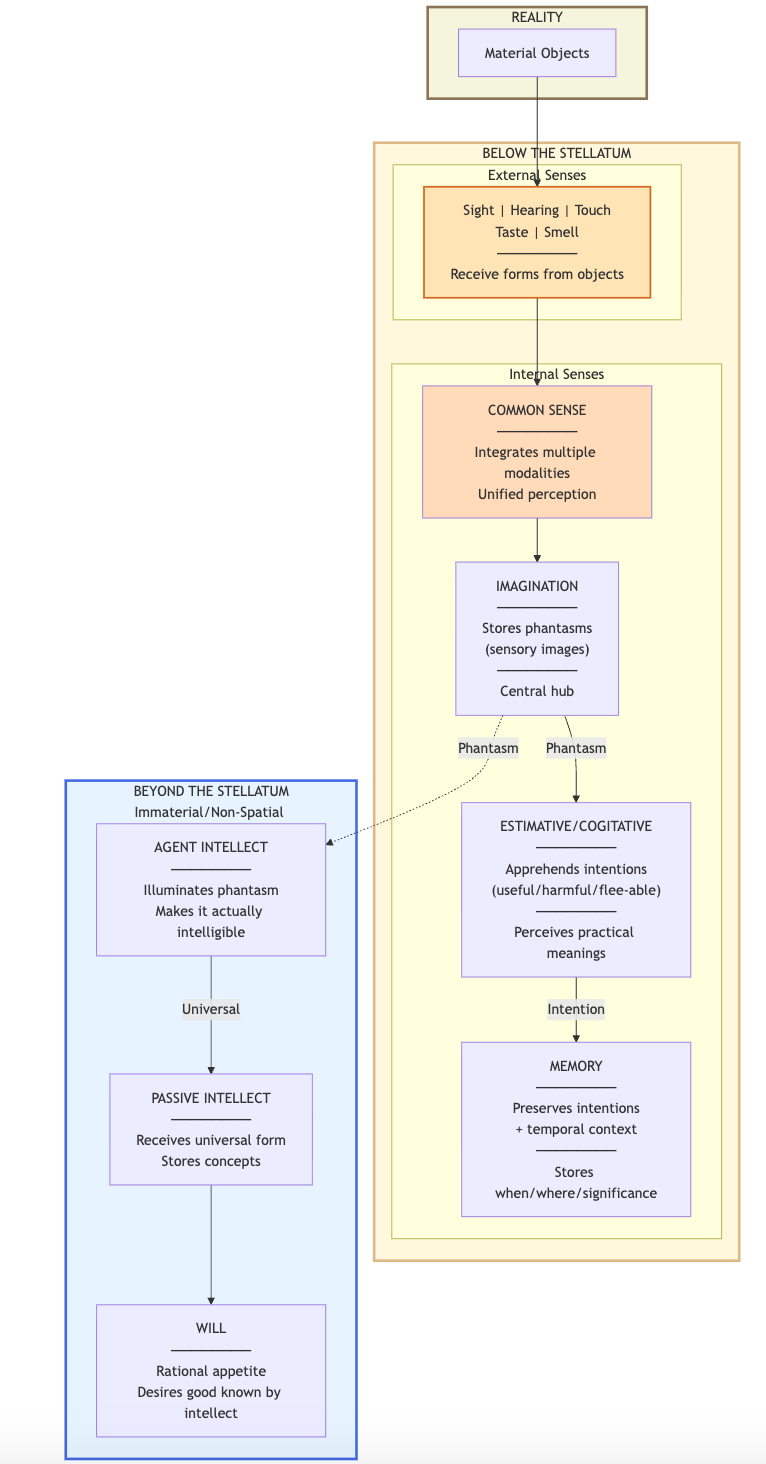
They include the external and internal senses.
External Senses
The external senses are the five senses: sight, hearing, touch, taste, and smell. They are the means by which external reality is sensed, and the starting points of all knowledge. These senses through the various organs receive sensible forms (color, shape, texture, taste, sound, etc.) of a particular material objects. For example, when the eyes spot a red apple, sight receives the sensible image of the red apple.1 Crucially, these are acts of perception—actual contact with reality through bodily organs. LLMs lack this entirely; they begin with words (which outward express a sensible thing), not sensible things themselves.
Internal Senses
Now, these phantasms do not stop with the external senses. They are internally received and preserved through the internal senses.
Common sense receives and integrates the various senses into a united phantasm of the material object received by the various external senses. The imagination preserves the phantasm—the sensorial representation of, say, a red apple. It is a “storehouse of the [sensible] forms.” The estimative power perceives the practical meaning from a particular image, such as whether something should be pleasing or disagreeable—whether something should be sought or avoided. This practical meaning is called an intention—not in the modern sense of “what someone intends to do,” but in the medieval sense of a non-sensible quality grasped through the senses (like “flee-from-able” or “nurturing”).2 Finally, memory preserves the intentions emanating from the estimative power and the particular context of a past experience.3 “[Memory] functions by remembering a thing, not absolutely, but as it was apprehended in the past by the senses or the intellect.”4
In other words, the imagination stores phantasms as an atemporal form; the memory stores the recognition of phantasms—that a phantasm represents something actually experienced in the past,—with the corresponding temporal (e.g., “yesterday”) and spatial (e.g., “at that place”) context, as well as the intention of something previous experienced.
Example: The sheep sees a wolf (phantasm stored in imagination), perceives it as “flee-from-able” (estimative power), and remembers “I encountered that flee-from-able thing yesterday in that meadow” (memory stores the temporal/spatial/intentional context of the phantasm in the imagination).
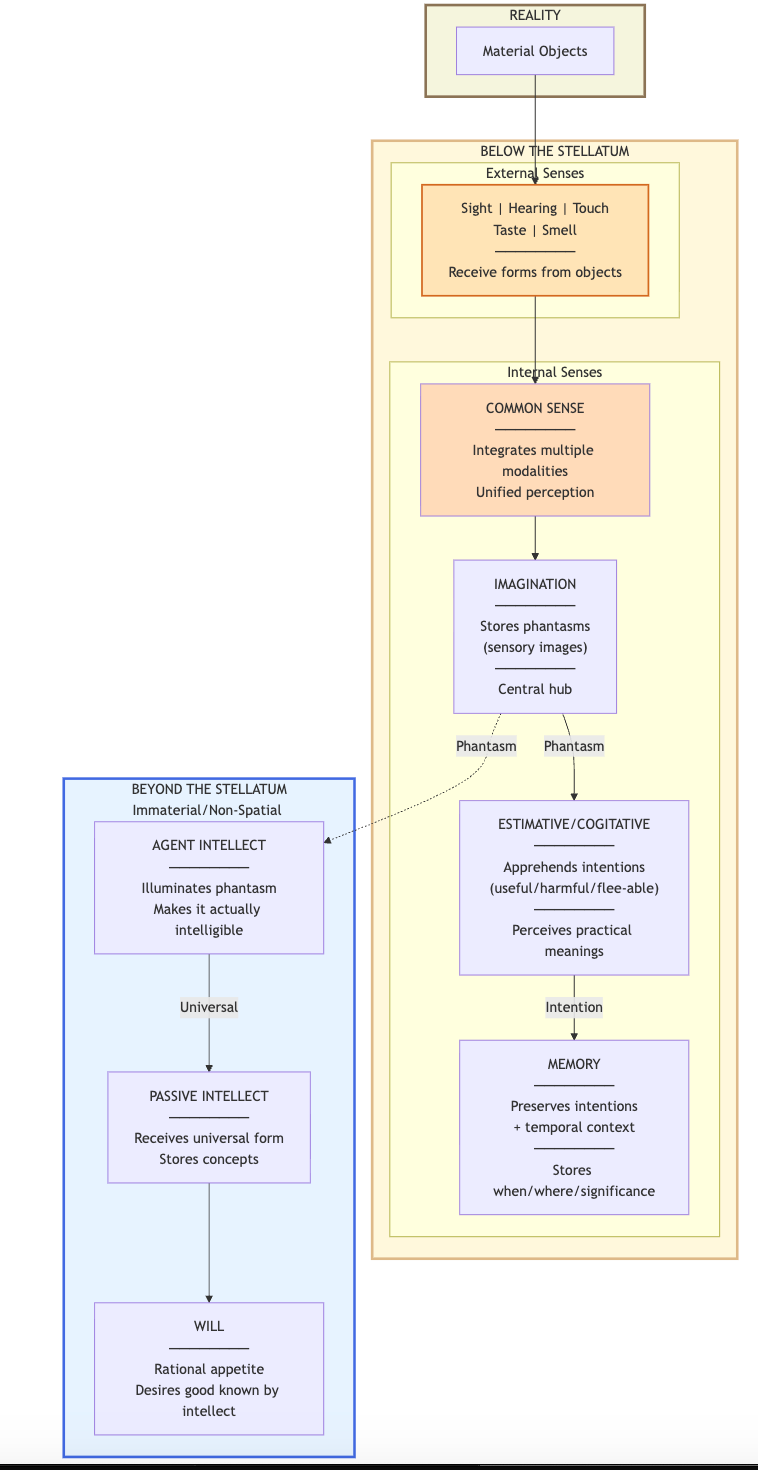
Moreover, “as to the memorative power (memory), man has not only memory, as other animals have in the sudden recollection of the past; but also "reminiscence" by syllogistically (through reason), as it were, seeking for a recollection of the past by the application of individual intentions.”5
Intellectual Powers
Moving beyond the external and internal senses, lies the realm beyond the Stellatum—that is, the realm that crosses from the spatial animal to the non-spatial intellectual powers that are subsistent operations of the soul (not the soul animating the body as an instrument). The ability to ascend to this realm (so to speak)—to possess intellectual powers—is what separate humans from animals. It is also what separates LLMs from actual intelligence.
Specifically, with regard to the interaction with sensorial powers, the intellectual soul possesses the power to understand the phantasm as such—to comprehend what the sensorial thing is universally. When I encounter an apple, my external senses produce a sensorial image of an apple. This sensorial image (phantasm) is collected in the common sense, then the common sense is passed to the imagination where the phantasm is the stored. However, and this is what makes me human, the intellect actively “pulls out” the universal concept of “apple” from the mere phantasm. This “pulling out” belongs to the active intellect power, and the universal concept is received and stored in the passive intellect.6
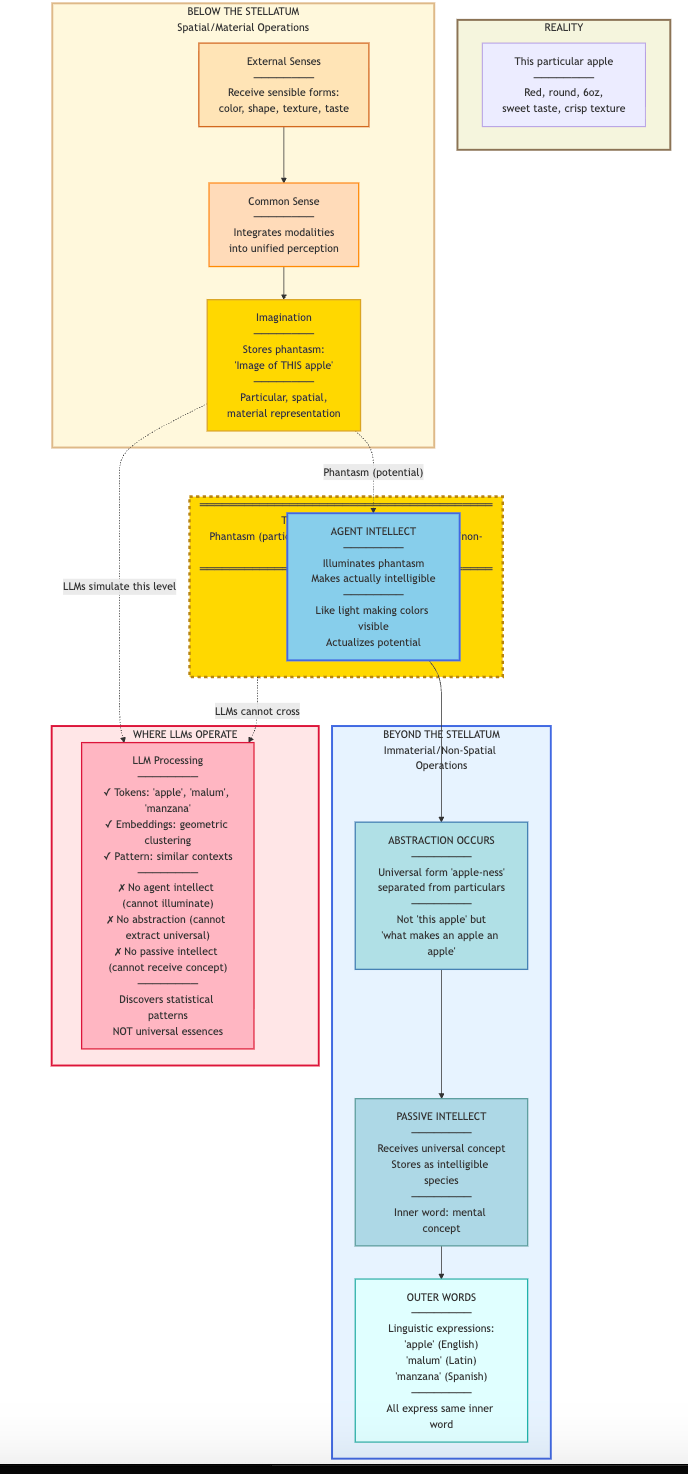
As Aquinas says, “The phantasms in the imagination are to the intellect as colors to sight: as colors provide sight with its object, so do the phantasms serve the intellect.”7 The phantasms are like colors—objects that have the potential to be seen; the intellect is like sight—it actualizes this potential, seeing these phantasms for what they are universally and storing them as universal concepts. If I see an apple again, my mind knows what an apple is—not because of the word “apple” per se, but because of the concept that the word “apple” represents. Hence, concepts are the universal form stored in the intellect (an inner word); words are the linguistic expression of the mental concept (an outer word).
LLMs and Quasi-Intelligence
LLMs are not living things—they have no soul, no self-initiated movement toward an end goal, and they obviously do not possess the five external senses. They never encounter reality directly. The starting point for words is not sensible experience (the experience of encountering material objects), but textual experience (the experience of encounter words of a particular language). However, given what we have said of the distinction and connection between inner word and outer word, the words language models experience are expressions of real mental concepts (inner words) that ultimately originated from contact with material objects through the external senses. In this sense, language models are able to visually represent real concepts as “vectors” in a geometrical (“embedded”) space—they accidentally possesses geometrical representations of real things.
Moreover, these geometrical representations of real words (vectors)—and hence, real concepts—give spatiality to a concept, which I suppose is akin to how our brains spatially represent concepts as phantasms. Vectors and phantasms, therefore, have an analogous connection. The embedded space of LLMs, and the vectors therein, may indeed be an artificial “neural network.” However, so long as I hold that the human soul is subsistent—as made evident by its subsistent powers of understanding and willing—then the brain, nervous system, or any biofunctional part studied by neuroscience is beneath the intellectual soul—and organized and animated by it (not vice versa). This leads me to conclude that LLMs can never attain true knowledge, because they are—at most—an artificial neurological system, an analogous geometrical representation of real concepts. Not only is it artificial, but even if it were real, it would be beneath the intellectual soul and is powers (not the producer of them). The form (soul) animates the matter (body—and all its parts) not vice versa.
Nevertheless, it is true that LLMs can process information dynamically, generate novel outputs, simulate cognitive operations, and learn patterns from training. This is evident—but again, so long as they are ultimately spatial representations and subsequent eloquent manipulations of them, then they cannot possess the intellectual power of intelligence because the intellectual soul and its powers are immaterial, non-spatial. They are “beyond the Stellatum.” This is not a technical limitation to be overcome with more parameters or better architectures. It is an ontological boundary. No amount of geometric sophistication crosses from spatial to non-spatial operations (to beyond the Stellatum).
However, given what we’ve said about the internal senses—and specifically the common sense, imagination, and memory—it is plausible that language models are able to represent phantasms as geometrical structures, and transform these structures (in the embedding layer—just as phantasms dynamically evolve in the imagination); to geometrically “intuit” various kinds of relevance between tokens in a set (in the self-attention layer), and like common sense, to integrate various phantasms from a token set into a a single phantasm (like contextual vectors generated in the self-attention layer); and to append to apply memorative context to know how to move from from a dynamic vector to one that matches the current context (in the feed-forward layer), which ultimately generates the next word.
In the past, we might be biased to ignore such striking connections as unnecessary philosophy—but perhaps the quest of the theoria and techne both demand that we take serious philosophical anthropology.
Aquinas, Summa Theologica, Part 1, Q. 78, Article 3.
Aquinas, Summa Theologica, Part 1, Q. 78, Article 4.
Aquinas, De Memoria Et Reminiscentia, Lectio 1.
Aquinas, De Memoria Et Reminiscentia, Lectio 2.
Aquinas, Summa Theologica, Part 1, Q. 78, Article 4.
Aquinas, Summa Theologica, Part 1, Q. 78, Article 3 & 6.